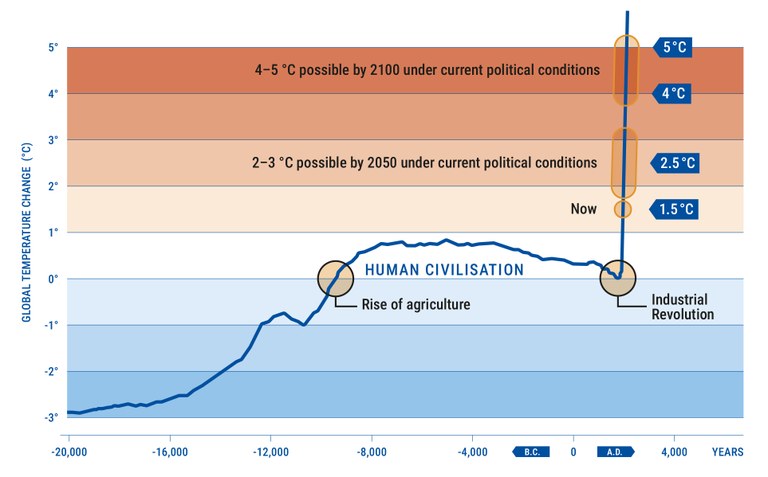
The physics, however, don’t change, and neither does the task in front of us.
I just spent ten months finding a job, the longest and most difficult job search of my career. It was hard because the macro environment is terrible, but also because I insisted on finding a role working on clean energy hardware.
At a time when basically all VC funding, and in many ways the entire productive capacity of the economy, is shifting to AI, it would have been smarter in some respects to just pivot to AI. I sat out the crypto bubble too, in which some of my peers made a lot of money by working on projects that were either useless, or straightforward scams.
We crossed the 1.5 degree threshold because the money can’t help itself. The slow, steady work of transitioning away from fossil fuels is never going to be as profitable, as quickly, as the various forms of gambling and addiction that have driven the tech industry for most of my lifetime.
But you, individually, can make the choice to keep your eye on the ball. You can commit to working on this problem until it’s done, no matter what. You can choose to find the others to organize and prepare, so that the ideas closest at hand when the next crisis comes are yours.
It’s the best solution I’ve come up with so far, and in spite of the challenges, it’s still working.
My opinion is that the very first things people should do are:
1. Get a little bit informed. It doesn't require a PhD, it could be done instead of a fraction of the time they spend scrolling bullshit on their smartphone.
2. Accept the situation. Too many are in denial, with variants of "it's not that bad" or "it's because those in power are stupid, I would certainly fix the world" or "it's because of foreigners".
3. Vote accordingly.
It's too easy to say "we don't have any viable candidates" and "I don't understand why they haven't fixed the problem yet, they must be stupid (somehow implying that "in all likelihood I would have solved it by now")".
In relatively-functional democracies, the reason the people doesn't have viable candidates is because the people does not vote for competent people. Either because they vote for competent politicians (with modern politics being about getting elected, not exactly solving big problems) or because they proudly vote for extremists (which is of course even worse).
In a democracy, the people is the government. When the people says "the government is stupid", it reflects on the people. Maybe they're right: the government is stupid, because the people is stupid and elects stupid people, and that's why we're screwed.
Glueing to the streets and alike?
I never found that to be helpful. Preventing chopping down forests to open new coal strip mining on the other hand .. I would be with you.
https://en.wikipedia.org/wiki/Hambach_Forest
Glueing to streets can lead to terrorism charges, taking part of a demonstration even if it is not a legal one so far not.
(but among those activists there are certainly more radical elements, also actual eco terrorists, they recently showed solidarity to someone who was hiding close there, who made attacks on power plants and transmission lines)
The ones that made Hambach happen were the people that camped there in the woods literally for years in tree houses and they (some of them) also got arrested for it.
There was a lot of intentional ideological violence towards police. Part of the reason why I did not engage with them further, but I know people there.
They still camp there btw
Also now with social media, you can find a lot of example of what are called in France "Appariteurs" who often start the mayhem then leave through police lines without getting arrested.
Yes yes, I heard that before. Let's just say I have been to many demonstrations and know the scene so sure, unprovoked police violence is a thing. But otherwise the pattern I witnessed quite often(and especially in the context of Hambach) is: some throwing stones or worse at police, police reacts with batons and teargas .. "wah wah, evil police!!"
When you have ACAB as a mantra and the core group consists of left wing extremists, what do you expect?
The openly showed solidarity with someone doing literal sabotage attacks on power plants and transmission lines. They are beyond reason and I claim the Hambach was temporarily saved not because, but despite those radicals. The mass demonstrations were what helped.
You make it sound like you proved I was wrong... somehow? I never said "0% of the world is informed and votes accordingly". I said that the majority isn't and doesn't.
Sure, once you realise you personally aren't able to change that, you can move to the next thing that makes you feel good (in this case working on "green tech", if I understand correctly). Some people go live in a hut in the woods.
Doesn't change the fact that the people is the government, and can generally vote for change. But they don't, for many reasons, including "they actually spend very little time thinking about those things". I would argue that most people spend vastly more time saying that the government is stupid than actually getting informed on problems and what it would take to solve them.
Another 8-9% is from India which while still classified as a flawed democracy is borderline.
And 11% is in the US which I guess we will find out if it is a flawed democracy or hybrid regime over the next few months. But at best it is paralyzed by polarization on the issue. And also due to lobbying/bribery from oil producing nations and states. The electoral system enforces two party rule which caused this problem in many nations, most of which are no longer classified as democracies.
These are also incidentally the nations best poised to solve the engineering issue of maintaining modern QOL while reducing emissions. The US has certainly contributed and China is working the issue very aggressively, largely out of a need for energy independence. But both of those contributions are fragile. The polarization is affecting it in the US and if China secured sources of energy that were cheaper but emitted, they would not hesitate.
And we all import tons of stuff from China. Stop importing from China if you want to reduce their carbon footprint. Instead of paying them to build cheap stuff and then complaining because they build stuff for you.
Oh yeah well your country produces more emissions than Vatican City. Since absolute emissions are bad, no matter the size of the country, your country sucks too. Every country that isn't in last place for emissions sucks! Get your emissions down to Vatican City levels otherwise you're just as bad as everyone else /s
> are not amenable to international plans to reduce emissions
Please tell me more about this. They're actually flattening or reducing emissions. They signed the Paris agreement.
> Want to see the ourworldindata graph (again, probably)?
That graph tells me North America and Europe combined produce the nearly the same as China. That means if they go 0 carbon tomorrow, it's like taking out one China's worth of emissions. Is that futile?
North America and Europe have also emitted way more cumulatively than China. Historic emissions are the cause of problems today.
Here's another ourworldindata graph: https://ourworldindata.org/grapher/cumulative-co-emissions
If you tell me "historic emissions" don't matter then I have to ask, where is the line? Do China's emissions yesterday also not matter? That's historic too, right?
> They're actually flattening or reducing emissions.
Reeeeally. Not reflected in the graph yet. Which of those is it anyway, flattening out, at a third of global emissions?
I've heard "historic emissions" before. You haven't reached for "per capita" yet. "Lump all the other countries together and blame it on them" is a new one. But what are you doing? Trying everything not to blame China, why?
> Do China's emissions yesterday also not matter? That's historic too, right?
That one doesn't even work, I could just agree that it's all about today's emissions.
I'm not aware of a dictionary which defines "most" as 31%.
> Not reflected in the graph yet
Actually it is. The graph you yourself shared. And it only goes up to 2024. The following year had actual reductions.
https://climateactiontracker.org/countries/china/
> Trying everything not to blame China, why?
You're trying everything to blame only China. Why?
> I've heard "historic emissions" before
And you think they don't matter? What do you think is warming the planet right now?
> You haven't reached for "per capita" yet.
Hey if per capita isn't important then get your country into last place. Until then it sucks just as hard as every other country not in last place. That's what you're saying, not me.
Yes, I think who did what in the past is irrelevant to solving a problem now. What's that for, punishing sinners? Not the goal. We can decide that it's not morally China's fault (ha), but they'd still be the ones doing it, and it would still be hot (in the future, the only controllable part).
I can't comprehend this "last place" stuff. I think your idea - or ideology - is that the West is responsible (as in having agency) and blames China as a distraction. This flies in the face of the plain facts of where emissions come from and which entities have control over that, specifically the CCP and the CCP.
And you believe this government will be able to order the population to stop burning fossil fuels, go back to living pre-industrial lives? Heck no.
That government was however able to order far-seeing investments in solar panel and battery manufacturing (done for national security, not climate, but who cares).
Even if China went 0 carbon, it wouldn't solve climate change because the other 69% of emissions would continue. Existing emissions will go on causing heating. Everyone has to make a change.
China for its part has done a ton of heavy lifting with its 31% of emissions. It manufactures abundant panels and batteries which make the transition cheap for everyone.
> Yes, I think who did what in the past is irrelevant to solving a problem now
You may think so, probably because you live in a rich country. But the people in developing countries asked to sacrifice in solving the problem do not.
If you move into a shared house with existing housemates, would you accept that you have to clean the already-disgusting bathroom prior to moving in because you have IBS and would use the bathroom more after moving in? You'd say "fuck no the people already living here messed it up".
That's what convincing developing countries to abandon fossil fuels at great personal cost is like. Make it cheap for them and they will do it. But if they see Westerners driving SUVs and flying everywhere, it's the same as your average Westerner's resentment of Elon Musk's private jet.
> they'd still be the ones doing it, and it would still be hot
Only 31% of it. Not even most of it. It would still be hot if they stopped.
> I can't comprehend this "last place" stuff.
It's the same as your "first place" stuff. If "most emissions" is terrible and everyone else is blameless, then "least emissions" is unalloyed good and everyone else is to blame.
> that the West is responsible (as in having agency) and blames China as a distraction
I think everyone is responsible and the West blames China as an excuse to do nothing (probably China does the same internally, I have no idea). Most emissions happen outside of China and are very much within the West's power to affect.
China, you mean, not changing the subject?
> asked to sacrifice in solving the problem do not.
So you mean that China wants the west to make some emission reductions, and then China will cut back on industry. I'm inclined to think they might be happy just with the first part and not bother with the second.
I think their 32% is instrumental to the rest of the world's political will, so I'm pretty much saying the reverse of what you're saying. This might indeed be a "you first" sort of situation, but there's no credible dialog about it anyway, Paris Shmaris.
No I mean all developing countries including China. For example, India's emissions are rapidly rising and people in the West love using that as a secondary pretext for their own inaction.
> So you mean that China wants the west to make some emission reductions, and then China will cut back on industry.
China already has reduced fossil fuel use in electricity generation and industry. I gave you two sources earlier. Here's a third: https://ember-energy.org/latest-insights/china-energy-transi...
Now if you're intent on blaming solely China regardless of the facts, I really can't help you. You should examine your blindspots and biases before continuing the discussion.
> I'm inclined to think they might be happy just with the first part and not bother with the second.
I'm not. China is more exposed to climate change than most Western countries. And also PV and batteries are legitimately cheaper than burning coal. So they might just race ahead on sheer economics while we bicker.
> I think that 32% is instrumental to the rest of the world's political will,
I really don't think so. They'll just pick on India or some other poor country trying to haul themselves out of poverty. Because "political will" was never about what China or India do. It's about protecting the fossil fuel industry and its cheap energy.
A ton of carbon is a ton of carbon. It doesn't matter who reduces their emissions. Since we both agree on that logic, then the question is "who reduces emissions first?".
To me it's obvious: the richest countries first, because they have the most money to do it. This is where our views diverge.
Why is "trying to haul themselves out of poverty" an excuse for causing climate change, by the way? That's a good trade-off, you imply? Being a poor underdog means you can have a dirty industrial revolution, because it's only fair that you should get a turn at burning a load of coal, is that the idea?
You say "China is more exposed": do they - anybody influential in China - actually express any concern about it? I don't know either.
It's a better reason than "I like hamburgers and steaks, big cars, and jet travel". Do you imply the West's choices are somehow nobler? Or is it ok because those "sins" as you call them are grandfathered in?
What are a poor country's choices? Stay poor, climate change happens anyway, and now they don't have any money to deal with it. Or get rich and have a chance of surviving.
> Being a poor underdog means you can have a dirty industrial revolution, because it's only fair that you should get a turn at burning a load of coal, is that the idea?
They would happily use free or heavily subsidized solar panels and batteries instead. Rich countries could easily fund this and tariff anyone who still burns fossil fuels. Why not do that instead of going "It's useless to do anything because China blah blah"?
> do they - anybody influential in China - actually express any concern about it?
They have targets to reduce carbon emissions, energy consumption per unit of GDP, particulate pollution, non-fossil fuel energy in total energy consumption, and increase forest cover in their current and previous 2 5-year plans. I didn't go back further than that.
https://en.wikipedia.org/wiki/13th_Five-Year_Plan
Russia not so much, the melting of the perma frost might even enable agriculture in some regions previously impossible.
China will also suffer strongly, they know this so they are investing heavily also in resilience measures. anti desertification measures in the green wall, Water management, even geo engineering (which caused some tensions with india about raining off clouds before the water drifts away)
Source? Climate change causes a lot more issues than just "it's a few degrees warmer", are you aware?
Like... extreme weather events and biodiversity loss, for a start.
That is not true in large parts of the world. Now even the most absolute monarchy has to listen to the people sometimes, but they absolutely can and do choose to do whatevery the small power circle on top wants, as long as the situation is somewhat under control for them.
That completely ignores realities of society, power and influence, even in democratic societies.
> Maybe they're right: the government is stupid, because the people is stupid and elects stupid people, and that's why we're screwed.
Now you’re getting it. But they are stupid for a reason. The people are stupid because they are poorly educated and distracted by entertainment; they are poorly educated and distracted by entertainment because policy makers prefer passive consumers to active citizens; despite the long-term downsides, policy makers choose to create passive consumers because they are easier to control and unable to contest their power.
One of Reagan’s advisors warned that free higher ed was creating a dangerous “educated proletariat”, and he was right! The response to this danger was to end state funding of college tuition, to strip out funding for the humanities, and to gradually turn colleges into job prep centers rather than centers of higher learning. (This process started in earnest with Reagan, but you’ll notice that it was never rolled back.)
People did try to fight this, but we lost. And now here we are.
First, you apparently do know candidates like that, so...
Second, the reason we don't have candidates like that is because the candidates who get elected are the ones who do what they are doing now. Extremists get elected by being extreme, and they are because the people vote for them. If the people voted for consensual candidates trying to get the people together to find solutions, then we would have more of those. People in the US voted twice for Trump, no wonder all the other candidates are looking more and more like him. You get what you vote for.
> The people are stupid because they are poorly educated and distracted by entertainment; they are poorly educated and distracted by entertainment because policy makers prefer passive consumers to active citizens;
I don't know why people are stupid, but one thing I know for sure is that there are enough resources out there for them to inform themselves. And most people in Western democracies are educated, so they are capable of getting informed. They just... don't do it. Laziness maybe?
I would argue that in order to solve systemic problems, it's not enough to "randomly vote correctly once in a while". It needs to be carefully built.
I'm not surprised at all that "randomness" results in us not tackling the biggest problems our species has been confronted to.
This, folks, is the power of neoliberalism distilled. Is there a problem? Why, it must be the fault of the many individuals who failed to take the appropriate action. Of course there is no consideration that many individuals together encompass a group who may be part of a larger system in which causality flows both ways.
Your comment here is not so different from accusations against “the blacks” (“why don’t they just stop committing crimes?”) or “the jews” or other groups. It is a simple reformulation of the classic “pull yourself up by your bootstraps”. Obviously, if you fail to do so, it is a moral failure. Obviously.
The fact that this outlook infests so many minds is exactly why we have ended up here today.
If the trajectory continues, one day the people will pull themselves up by their collective bootstraps, and a real nightmare will begin, because such things are never clean.
> Why, it must be the fault of the many individuals who failed to take the appropriate action
I am actually addressing the opposite: people tend to say "it's because of the few in the governments", as if they themselves would do better.
> Of course there is no consideration that many individuals together encompass a group who may be part of a larger system in which causality flows both ways.
I don't understand the "causality flowing both ways" part, but for the rest, that's EXACTLY my point. People are collectively part of a system, and they are collectively NOT solving the problem at all. And in relatively good approximation, they are blaming the people THEY elected.
Now being part of a system and not having the power to change it individually is one thing. Being part of a system getting worse, complaining all the time about it getting worse (to the point of going in the streets and burning cars/schools), but not being able to actually realise that it is more complicated than "it's not my fault, it's the elites"... Well I don't know how to call it, but it's tragic.
The only way this changes is if there is real political/government leadership on the issue. That leadership can direct national resources. It can legislate. It can even tax - if necessarily to a very high degree - less useful ways of spending available resources in the private sector to deter waste.
We can't get that kind of leadership in many countries at the moment because too many people will just vote for whichever party they always have or whichever populist nutter has the most convincing sound bites. So before the political problem can be resolved there needs to be much more public education on the realities of the issue.
This is unfortunately a circular argument because the public information campaigns that are needed to fix the education problem are only going to be run by political/government leadership of the required calibre. If anything the populist lightweights will push the other way because dumbing down the voting population helps to sustain their own control and importance.
My hope is that before it's too late there will be enough politicians who are both capable of dealing with the real issues here and capable of taking on the populists convincingly enough to get elected to start moving the needle. Unfortunately I don't really see any other way this gets fixed instead of spiralling downwards.
I got educated in public schools. I was given all the tools needed to get informed and understand the problems well enough to... well at least not vote for extremists.
Saying "it's not the people's fault, it's the government that actively prevents them" is wrong in my experience. Even when the public education is good enough, extremism rises as soon as life becomes harder.
A recurring problem with politics is that even a lot of decent and reasonably intelligent people still aren't interested enough to spend a lot of their time looking into political issues in detail. And that's understandable! Most adults have enough to worry about with jobs and families and their own hobbies and interests. The point of representative democracy as commonly used in Western nations is to have representatives who can devote their time to getting involved and understanding the issues on behalf of those they represent. But then how do voters know that the people they vote to represent them will take a good position on the issues that matter to them? A lot of it comes down to rhetoric and trust - and that's how folksy populist politicians manage to win votes and get elected even if better informed voters can see straight through the sales pitch.
The kind of public information campaigns I'm talking about here are the ones that try to raise awareness of the most important points about the most important political issues among the general population who can't or won't do enough research to find out for themselves. It's about getting the core message and basic facts to enough people who would then support doing sensible things as long as they have that essential information. But of course there can be a fine line between public information based on facts and logical reasoning from one party and mere political propaganda from another. The same tools of government and taxpayer funding can support either in exactly the same way - depending on who is already in power at the time.
Yep, George Carlin said this best when he was still alive. Bad Government is simply garbage in, garbage out, if the people are stupid, they will elect stupid people
This is just not true. There are many reasons so-called democratic elections fail to capture the will of the people. One of them is that many decisions are bundled into one, so lower priority decisions get sidelined by high priority ones.
The problem here isn't the people, it's a system that is built to have the appearance of being run by the people, while in reality the people will never be given reins to the system.
In Switzerland, the people can actually collect signatures and then vote to add articles to their Constitution. So they are very much in control. Check what they have voted in the last few years. When you ask the people, they actually don't give a shit about the climate problem. Then they say the problem is the government (not sure if they say that in Switzerland though).
You shouldn’t want political solutions to solve this - you want economic ones. I’ve been driving EVs almost exclusively for almost a decade and happy to see less smoke in the air, because and increasing number around are doing the same. Having solar during massive energy price spikes has been awesome. Tech that converts carbon from the air into bricks or some new type of fuel that generates revenue would quickly make factories want to capture it. Crops that grow in dry areas or tech to capture water and energy locally made affordable will increase local economies in countries that currently have so little that war is the only thing on the docket.
Forcing people to change what they eat or to pay reparations to countries that actually cause the pollution (much climate change action funnels money to China) or to lose jobs and factories will get you into war, because that’s precisely what authoritarians like Putin and China use to subjugate Europe.
Merkel did after Fukoshima and with broad public support.
Merkel government wanted to postpone the nuclear phase-out, but after Fukoshima, reverted to the original Red-Green nuclear phase-out.
https://en.wikipedia.org/wiki/Anti-nuclear_movement_in_Germa...
Huh? Who has China invaded this year? And the USA?
Run your statements though an evidence filter first.
It also dismisses the fact China's pollution is everyone's pollution when they make most of the crap we buy.
the government isn't stupid -- it's smartly serving the interests of the wealthy, who are primarily concerned with increased profits in the companies they hold shares in, not the wellbeing of Americans (much less those in other countries)
the US gov for the most part, has always been pro-owners (a small minority), not pro-workers (the vast majority of Americans) -- it's a structural feature, not a bug. and that's why it's so difficult to change unless things get so bad and the threat of social revolution is so great, that the gov is forced to make concessions -- this mostly only happened once, during the Great Depression
> In a democracy, the people is the government
sure, in theory. but in the US you'd have to start by overturning Citizens United so that the people -- not corporations -- are the ones driving elections
Hard disagree here. Having a PhD only says you got hired for a PhD and spent years doing stuff. Doesn't make your opinion better than a scientific consensus. Having a Nobel Prize means that you won the lottery when you chose your field of research (if you were lucky enough to have a choice there). There is a famous "regression to the mean" with Nobel Prizes who then have a tendency to be confidently wrong for the rest of their life.
Not saying that PhDs and Nobel Prizes are worth nothing of course. What I'm saying is that science is about consensus. It's okay to believe that the consensus is wrong and to try to prove it, but until you manage to do it, you have to admit that the consensus is the best theory we have.
> This is not to take a position but to point out that they can hardly be idiots; if you think they are, this needs to be made plain.
I don't think they are. I think people tend to misunderstand how science works.
If the vast majority of scientists in a field agree on something, and few disagree, that's perfectly normal. Now when you take one scientist from the minority, realise that they are not stupid, and conclude from there that it would be rational to believe that the large consensus is wrong... then you are doing it wrong.
In other words, a scientist could say "you should believe the consensus about global warming, but my research is about trying to prove them wrong. Until them I have failed, given that the consensus is what it is, and therefore you should not base your survival on my ideas". Of course they won't, and in all fairness it shouldn't be their job to say that. We really just need people to understand how science works, and stop thinking that they can select the one study they like and say "it's true, I choose to believe this one".
The problem is that as soon as you start digging into it, you're essentially walking in a guilt trip.
The kind of "eating an hamburger pollutes more than driving an SUV for 50 miles" guilt trip.
And you realize most of the focus should be on materialism, consumerism and how/what you eat, not just cleaner transport.
But who really wants to do so? I myself am aware that me eating a beef steak per week has a gigantic impact on environment and resources. That switching to pork > chicken > eggs in that same meal would be better.
But I just don't want to enter the guilt trip. So I do a bit, but not as much as I could.
A carbon tax should help there. Make it so me eating a steak is not incentivized. But then good luck with farmers, the easiest like and empathy grabbing category of workers on the planet.
Eating a hamburger or driving a car is not the problem at an individual level.
These companies are: https://www.theguardian.com/environment/2019/oct/09/revealed... Going to bet not much has changed since 2019.
You can't vegan hamburger your way to terminating those enterprises. You can tax, regulate and ban them though; and use the revenue to help society adjust.
Telling people that eating a burger is somehow having a huge environmental impact is nonsense, and it becomes rather obvious it's just promoted by people who want to promote veganism for philosophical reasons who have hijacked the environmental reasons.
It is also a complete no-go in China where veganism is viewed with suspicion because it is associated with religious fanaticism.
You can't tax, regulate, or ban them when people still eat hamburgers. Who would vote in favor of that?
But if enough people eat vegan hamburgers...
We have living proof that laws against meat get passed when voters eat less meat: https://en.wikipedia.org/wiki/Cattle_slaughter_in_India#Legi...
In this case the motivation is religion, not environment. The outcome is the same though.
Strongly disagree. Oil is not getting produced because a handful of companies want to ruin the planet-- that happens because billions want those oil products, for personal mobility, cheap goods, cheap energy.
A lot of people simply don't care enough about the future consequences; they want to continue cheap consumption for as long as possible, and find justifications and excuses easily enough ("China emits so much more anyway", "I can't afford to pay more for gas", "why should I have to make any sacrifices that my parent generation did not have to make", etc.).
If you could disperse every last one of those companies into tiny 20-man operations, you would solve absolutely nothing. What would solve things is if a majority of people (in industrialized nations) would become willing to pay the cost for fast and extensive (green) electrification, to downregulate the size and frequency of personal transport, to pay a premium for green concrete and steel, to accept higher prices and worse availability in order to sanction any trading partner that is not similarly serious about emissions.
We can't get any of the above not because of evil corporations or politicians, but simply because most people just don't want to pay the price and make the sacrifice now for a better future.
No socialist/lefty has been elected in the US despite their ideas being super popular. Don't act like voting for a centrist dem like Biden would do anything but ever so slightly slow the climate change scenario we're in. We absolutely need and FDR new deal scope of attack on this problem.
The dude engaged in more climate action than any previous president. The Inflation Reduction Act was a huge clean energy manufacturing bill. This is established fact that isn’t even really disputed from what I can tell.
Remember those EV subsidies that disappeared under Trump’s second term? Yeah, those did more to curb fossil fuel consumption than just about anything else the government could have done with direct action. Transportation accounts for 28% of greenhouse gas emissions in the United States. The US is wildly car-dependent. The government should be practically forcing US auto buyers into EVs through EV incentives and gas taxes.
In your world, Joe Biden was the modern day Abraham Lincoln, and the Russian propaganda firms are working overtime on HackerNews "smearing him".
In reality, Joe Biden was a career politician because he'd say whatever needed to be said to be elected at the time.
Being a career politician doesn’t mean anything positive or negative without further context. All that means is that you are winning elections.
You can be a career politician because you are popular and effective, or you can be a career politician because your political machine has done a good job of keeping you in power — or both.
Bernie Sanders has been in congress about as long as Susan Collins and they are definitely not the same people in terms of the integrity of their ideology and congressional voting record.
The rest is changing the subject - derailing and inflammatory.
These viewpoints are exhausting.
A little informed about what? That we are destroying the planet slowly? Yeah, we know.
What is your actual solution? That we tell people they can't have plastic straws? That we need to install solar and wind farms (which is already happening at mass scale in the West, by the way. That includes the US)?
What are you actually proposing? That we "vote"? Do you want to de-industrialize your corner of the world, like Europe is doing, while the rest of the world plows ahead unabated?
Until you're ready to go to war for this, it's unrealistic. And good luck trying to force any country to do anything you want without a well equipped war-machine. You think Russia, India or China care what Europe thinks about their climate policies?
So, yeah, go ahead and vote in your green parties.
There is no easy solution. If you think that installing solar and wind farm is "a solution", then... you misunderstand the size of the problem.
> What are you actually proposing?
Get informed, work your way towards accepting how bad it actually is, and then work your way towards accepting that life will get more complicated and that we have to work together to try to keep is a bearable as possible.
As long as people will be adversarial (like you are here, criticising green parties for no reason, I don't even vote for them) we'll be screwed. As long as people will go in the streets because "life is getting harder", we'll be screwed.
The only solution we have is to work together. And even if we do (we probably won't, but let's be optimistic), our life will get more complicated. That's why I say that the first step is to accept that. We won't solve the problem while being in denial.
That is a fundamental problem that you will not solve by asking youger folks, who are actually affected and have all reason to agree and comply, to make a change.
I get the feeling that many are confused and fear the literal destruction of our planet by accelerating warming.
The reality is that the underlying physics fundamentally work in the opposite way, with warming slowing down rather than accelerating. I understand that for warming below 2C, the confidence is high that it is roughly a linear relation to additional CO2 emitted.
I'm optimistic about most things in life, perhaps it's a flaw of mine.
I do think we have decades, if not centuries, to develop solutions to climate change. Our planet will remain livable.
That said, I understand some ecological damage that may occur with global warming could be irreversible, and it makes sense to reduce emissions as soon as possible.
Potential climate catastrophe scenarios where rapidly rising sea levels submerge many inhabited areas and various knock-on effects disrupt the food chain, even in those scenarios the planet is fine on geological timescales. What's not fine is human civilization, on human timescales. And I think this is what gets inadvertently hidden behind planet-saving rhetoric. If the worst case scenarios are "only" about billions of people dying due to resource scarcity and conflicts over said resources, this is something to be avoided.
I see a parallel with global nuclear war. Such a war would probably not end the species, there would be groups of survivors here and there. But human civilization as we know it would be over, with the global population being back to what it was in the hunter-gatherer era.
If sea levels rise significantly faster than over the last century, this seems likely to cause economic disruption, rather than threatening human civilization.
Even when we look at knock-on effects and food security, it seems very unlikely to threaten wealthy, developed countries with diversified food supply.
It is still going to disproportionately affect developing countries that are already struggling.
From what I have seen its more linked to affluence of countries than anything else.
I always cared. But I care more as I age. Why? Because I know (vaguely) the danger and I have ____KIDS____.
Older people usually have kids too. For anyone, ANYONE who accepts/knows the dangers we face to just shrug, knowing it's their own kids and grand kids that will suffer (wars, political upheaval, riots, deaths, migration) - no. I don't buy it.
Principally, it's the ignorance of the people to the things that matters most. Maybe they are partially sticking their heads in the sand a bit. But if it truly was properly reported on prime-time news and so on, they would know, and they would care.
I don't know a single person that isn't aware of the issue, it's just a significant portion of them think it is outright fake or they just otherwise don't care because they see it as a lame thing to care about. How does one fix that side of things? It seems a major impediment to any progress.
The split seems mostly generational; my parents and other parents around their age seem to not really care (there are still dinner table debates about whether Al Gore's An Inconvenient Truth was a scam or not), but as my other-millennial friends are becoming parents, the vast majority of them do care, because this issue has been so front-of-mind for people my age. We're hyperaware of the fact that my country has more wildfires, milder winters, and hotter summers than it did when we all were growing up.
(There may be selection bias at play here; while I don't go out of my way to avoid them, I don't have many friends who deny the issue of climate change).
Many of us are also tracking the second- and third-order effects of these things; crop failures, droughts, and the migration and public services strain that come as a result of this; most frustrating is that the biggest voter blocs won't enact policy that's responsive to this, so when the inevitable (mass, climate-change-driven migration) grows over the coming decades, we'll be unprepared, and we'll either be overwhelmed by the movement of people, or complicit in one of the greatest humanitarian crises in history (and very possibly both).
They are NOT, and the trend is pointing downwards. That is the demographic shift, which many call demographic catastrofe.
so better to just live in SF or certain areas of the midwest
where climate change won’t affect me
However my friends who have kids and grandkids care a great deal about climate change and generally do what they can politically (i.e. vote for Greens and so on) within the constraints of life (i.e. they're not out there throwing soup at paintings or whatever).
Maybe that's what it will take. I expect ecoterrorism to become a serious thing in the next decade or two. Who knew the Amish were right all along?
As long as you got money, you can afford to "save on CO2" and buy a prius or whatnot. The thing is, we can't really avoid making things that are bad for the environment without making everything expensive. You can ban a product, like oil or fosil fuels, but you are banning the best solution - which is often also the cheapest. If it wasn't the best/cheapest, then why would you need to ban it, people would not be using it.
Climate politics eventually raises cost of living. If we could lower cost of living AND save the environment we would be already doing it.
So all the measures to save the climate will inevitable impact the lowest income households the most. Which is - and here we close the circle - the young, working population. The retired one have the wealth and assets, as established earlier.
When the Amish said that modern technology destroys the family they weren't envisioning a climate catastrophe being the thing that destroyed the family.
I recently travelled to the primary old-order region of my country, where I hadn't been in about a decade, and all the horses in the fields I remember have now been replaced by tractors. Let's be real: They don't fear climate change any more than the average Joe does, possibly less having less exposure to the science and messaging. All they have ever feared was families being broken apart by the kids leaving for the big city lights.
Younger folks tend to be more enthusiastic about "making a change" by direct action means, so you shouldn't count them out!
Which is literally OPs point.
Here's the thing: Resources aren't extracted just for fun. It is only done so to serve the consumer, and those consumers are disproportionately young-to-middle-age adults. Not using resources is the only way to combat this. That is fully within their control.
IIRC,this is already true for some?
From the death of local newspapers, the end of classifieds and the pressures on ad revenues, journalism had no real options but to shrink and consolidate.
The more content we create, the more the market focuses on creating content that could garner attention.
People are going to vote based on the information they have. If they are part of a captive market, then they are going to pick between the choices they are presented or decline to participate.
It’s some sort of irony, that as a society we developed ways to neutralize free speech and expression by flooding the zone with more content, not by controlling content.
Like in my country there is a big election every 4 years and you have state elections in between. So any government needs to constantly appease the people to stay in power and do anything. It’s basically impossible for them to make and more importantly realise any plans that go beyond that 4/5 year timeframe.
And to solve something like climate change we would need to think in decades or centuries.
Not the same problems as democracy but I would argue that authoritarianism is even worse.
Unless you're doing those strange mental gymnastics of entities like oil companies are the emitters and not the consumers, that's not true. Old people who have gained large amounts of wealth have also lost large amounts of mobility and tend to not produce much co2 because they don't do much in life anymore, comparatively speaking. The data is clear that peak carbon emitters are in their 30s-40s, and they're still the ones most often seen crying about not being able to afford a home.
A third of CO₂ emissions come from a country that is not a democracy.
That will not work because it means people just move high emitting activities to those countries.
For example the evisceration of the British steel industry means we import steel from China: dirtier energy mix, plus transport of a very heavy commodity.
If you want to compare democracies to non-democracies then you have to add all the other non-democracies too which would give you more than half.
You are right that they don't have a democracy because the people are unable to truly organize without the powers that be at the top putting an end to any movements, but the people in the remaining 2/3s of the world never bother to take time to organize either, so the democracy they do have is really only a belief, something theoretical, and they if they ever decided to exercise it in the future may find out that they weren't actually under democracy after all.
If you want to be a senior SWE in clean energy, the Climatebase rec is good, or https://www.terra.do/, or subscribe to a newsletter like https://www.ctvc.co/tag/newsletter/ that announces when climate tech companies raise money (at the bottom of each newsletter), and apply to open roles at those companies when they start looking to spend their new money, usually ~1-3 months later.
But we all know the top 1% will make sure the US will never change so everyone needs to make sure they vote.
This sounds interesting. Tell us more?
Actual real reasons like possibility of continuous dark cold windless weeks in the winter and then the more common/real one. Politics.
Also if someone wants to build nuclear why would you not let them? More production in general is better as long as the public money put into it is the same per kWh produced as wind/solar/whatever why would I care?
Denmark, 2026: system-level LCOE including storage, flexibility and system integration; renewables substantially cheaper than nuclear.
https://www.sciencedirect.com/science/article/pii/S036054422...
Finland, 2025: nuclear scenarios 71–84% higher system cost; unrestricted least-cost optimization builds zero new nuclear.
https://www.sciencedirect.com/science/article/pii/S036054422...
Australia, CSIRO + AEMO GenCost 2025–26: whole-system modelling including transmission, storage and firming; renewables + storage remain the lowest-cost net-zero pathway.
https://www.csiro.au/en/research/technology-space/energy/Ele...
What are these grid operators and researchers missing that you know?
Also their listed cost of nuclear power is a lot higher then actual real cost (TVO lists these publicly but every study still uses numbers that are much higher)
Edit: and again if someone wants to build (and pay for it) let them. Electricity production here (Finland) isn’t some single system where someone has control over all the investment but a free market where everyone is free to compete. If you think that you can compete with your solution (and can convince the investors/banks) why should we be saying no you can’t? In electricity production where there is actual cost for CO2 this actually works.
For the record I am against the government giving some guaranteed tariff price (or any other direct subsidy like that) to any production method. If new nuclear can’t be built without such subsidies then we should not build it.
Really enjoyed this snippet of your post. Not sure why, but being in the weeds with it, it had never really looked like this is an industrial revolution style retooling of how we work, with the pain and benefits that come along with it.
Unfortunately my conclusion is that Climate Tech companies in general have been delusional thinking the mission is enough and there is no requirement to be a business.
The reason I am saying this is not to discourage from working in Climate Tech. The reason I say this is to please not go in with eyes closed which is all too common.
Climate Tech needs to grow and be sustainable both for the mission as well as a business. And for far too long I feel business smarts have been missing completely in this sector.
On the other end of the spectrum, there are several “climate tech” companies that abandoned the mission as soon as they raise a Series B
Pollution in the air they breathe, the water they drink and the soil their food comes from? That's something normal people care about and understand.
Climate change is a branding and communications failure. Fight pollution (bad thing) not "climate" or "change".
Why doesn't anyone understand this and rebrand?
Saying it is simply a "branding failure" is about as accurate as saying "planning failure" is why around 80% of Ukrainians lost power in 2024.
This is not true, it's fossil fuel propaganda that has been very successful. The overwhelming majority of people are concerned about the climate but assume that they are in the minority. See https://ourworldindata.org/climate-change-support for example.
"Fight pollution" is the old approach, it doesn't work as well because greenhouse gases are generally invisible and cause no noticeable short-term impacts, and because in the US the industry has been successful in distorting the law such that greenhouse gases do not legally count as pollutants.
It might not seem like it if you live under a broken political system that can ignore what people want and so that doesn't translate into action.
When you point this out people say, "well it's not as important as cost of living or health or migrants from hot countries or getting out of wars in the middle east" despite it helping with all of those too.
But in terms of politics we have Trump paying companies to abandon half-built offshore wind farms and various European countries offering subsidies for fossil-fuel consumption 'to help with affordability' to shield consumers from their dependence on a volatile source of energy.
And that is ignoring the huge and persistent subsidies dished out by governments (estimated at about $800 billion globally - which ignores the externalities like pollution and global warming).
If you think climate change is a problem, you're more likely to be on the left of the political spectrum and hold a wide range of other views that have absolutely nothing to do with reducing CO2 levels in the atmosphere.
(I'm not just picking on the left. Everyone does this with everything. It's human primate tribal behavior.)
The constant shifting winds are a result of political shifts and power struggles, often struggles over issues that are unrelated to climate change but are linked to it by this mechanism. It makes rational discourse and consistent action hard. The more bound up an issue is with politics the harder it is to even discuss reasonably.
Of course, people with a short term vested interest in not doing anything about this problem love it this way.
The problem is simple and the solution is to switch to power sources that emit far less CO2 or preferably none at all. This remains true regardless of our political, social, or cultural beliefs. Physics doesn't care.
People make things that are a matter of opinion (politics, religion, whatever) a matter of identity.
This is worse in the US than in most places, but its become a lot worse in the UK, which I attribute to create American cultural influence, especially as it has come at the same time as specific American ideologies.
Looking at our politicians and bilionairs - this seem to be the only sensible choice we have.
They think that personal acts of minor inconvenience like tolerating soggy paper straws saves the environment while fighting things that actually make a difference, like blocking transit to save a nest of bats; or blocking urban development to provide an extra 3 minutes a day of sunlight on a surface parking lot; or that somehow them flying across the USA to visit a national park and connect with nature or something is offset ecologically by token actions like reducing how many plastic grocery bags they use throughout the year. Most ordinarily people don’t understand the tradeoffs of their choices in the slightest.
And on top of that culture wars and geopolitics is getting in the way of progress - we could be blanketing the world in solar panels and batteries and EVs on the cheap right now, but it’s dominated by enemy #1, China, so we won’t; not to mention that the right in the USA seems to think that renewables are for girly sissies. And the alternatives we have, like nuclear power, are being shut down across EU countries because people have no idea of just how self sabotaging that action is, given that the alternative is going to be fossil fuels coming from Russia and the Middle East. They’d rather die of heat stroke than use energy efficient air conditioning, so the powers of most people’s imagination are shockingly weak.
Popular opinion wants to blame everything on capitalism when the reasons for these problems don’t actually stem from there. Capitalism will be the way out if it’s given the chance, but it’s not popular to say that, so it won’t.
I think that people do care about "the environment," but what they mean by "the environment" is much more "my personal connection with spaces that feel unspoiled" than "atmospheric CO2 levels."
Why should the average person reduce his/her life quality in order to save the climate, when the average billionaire emits as much CO2 as one million people from the bottom 90% of the population combined? I do care about the climate, but it's clearly irrational to make sacrifices, when other people are unwilling to do that. Having a higher quality of life is more valuable to me than the tap on the shoulder I can give myself for playing my part in living responsibly.
We do irrational things daily in order to live harmoniously in groups. Heck, the entire field of behavioural economics was stood on its ear when they figured out that humans don’t behave rationally in all circumstances. Moral choices are individual. I limit my QOL in many “irrational” ways because it helps me live with myself. Is it enough? Of course not. But we are too outnumbered by the greedy and the defeatists.
Read what you quoted again. That's not what it says.
It'll only be higher until things reach a tipping point. That point is only getting closer and very possibly within your lifetime.
But if more an more people changed their attitude, stopped envying jet-setters and instead shamed them for their environmentally reckless attitude, maybe you would see a lot less plane travel, a lot less gas guzzlers, a lot less conspicuous consumption.
Shame works on the vast majority of people. We may lack inherent ethics, but we seldom like to swim against the stream.
You realize that if everyone has that attitude then nothing will ever change, right? "You take the first step!" "No, you take the first step!"
> Why should the average person reduce his/her life quality in order to save the climate, when the average billionaire
I understand (and share) the sentiment, but there are not that many billionaires. Even if they all suddenly became vegans who never travel and live in a small house, that would not solve the problem. What the masses do is what has to change. How they travel, what they eat and buy and consume, their housing.
A quick google search indicates that the top 1% accouted for 16% of greenhouse gas emissions. https://www.oxfam.org/en/press-releases/richest-1-emit-much-... Yes that is a lot. But 1% includes many more thn just the billionaires and it also means that if the remaining 99% don't get their emissions in check, it doesn't matter much what the top 1% do, let alone the billionaires.
Don't get me wrong, I'm not saying the billionaires should not do anything. If anybody is in a position to adjust their behavior, it's them. But acting as if as long as the billionaires don't change their behavior, nobody needs to, is the route straight to failure, though it is a very easy narrative for sure.
8.3bn people on earth. 90% if that is ... more than 3.5bn? Something like 7.4bn? How can "the bottom 90%" be included in those 3.5bn?
And I also don't follow where the "a million people in the bottom 90%" are suddenly coming from. Which million out if those 7.4bn people?
I'm really at a loss w.r.t. your arguments.
This helped. It’s pretty much the only thing you can do.
The system is looking for growth, not for sustainability, which is someone else’s problem.
Not to mention, this is all going to assume resources in America and issues from an American perspective. Not to ding America, just that the conversation will cluster around the topics that matter to funders.
Which is why I think we need carbon pricing / tax. If the politicians focused on that then the forces of capitalism and startups would be unleashed to bring down co2. Instead they ban plastic straws while the Chinese burn another million tons of coal.
It could maybe be brought in quite gradually in a decade or two ahead so people have time to install renewables, heat pumps and the like.
I know it's easier to blame China than look at what we've done, but:
- The US generates more co2 per capita than China does.
- A lot of what China makes is products that we buy from them.
- The US has about twice as many CUMULATIVE co2 emissions than China does (remember, the co2 stays trapped in the atmosphere)
- The feds have gleefully killed as many clean energy initiatives as possible. Meanwhile, China leads the world on clean energy, has driven down renewable and EV batteries by 90% since 2010, is the world's largest renewable energy producer and investor, and is on track to generate half of its energy from renewable sources by 2030.
I'm not one for pedantic corrections but I feel like this one's important
You have heard of photosynthesis?
Only about 10% is reabsorbed quickly [1], the rest stays for hundreds or thousands of years. That may not be "trapped" in a pedantic sense, but it's pretty close.
[1] https://climate.mit.edu/ask-mit/how-do-we-know-how-long-carb...
I am with you with wanting carbon taxes, but it's not like there's a single issue that can ever be tackled at a time.
Ocean Conservancy has annual reports that include statistics from trash cleanup projects. The 2026 report[1] has a "global top items collected" list that covers 1986 to 2026; straws (& stirrers) are 5th at about 16 million items collected. Drinks bottles are number 3 at nearly 27 million. Cigarette butts are top (65 million)
Looking back at the report from the year 2000[2] as a comparison (this one lists numbers just for the year 2000 cleanup projects), straws are number 10 out of 12, cigarettes are still top, various other plastic items (not all of which are classified) are above straws.
[1] https://oceanconservancy.org/wp-content/uploads/2026/08/2026... [2] https://oceanconservancy.org/wp-content/uploads/2017/04/2000...
That's only true up to a point (see: efficiency, the length of logistics chains & so on). For the remainder, GHG footprint only holds for fossil-dependent economies.
Move to renewables & you're literally decoupling energy use from GHG emissions.
That only works if its global. Otherwise people just shift activities to somewher with a lower tax.
The chinese quite literally have greener energy than germany at the moment and are building the shit that you buy off of amazon. China is the only reason the current solar push is as successful as it is. Tame your sinophobia.
https://ourworldindata.org/grapher/electricity-mix?tab=line&...
There's still complications e.g if the "dirty" electricity is being used to power an EV or a heat pump then it's reducing GHG compared with directly fossil fueled alternatives.
The trend is interesting too: https://ourworldindata.org/grapher/energy-mix?tab=line&count...
> nd are building the shit that you buy off of amazon.
So not buying Chinese made stuff on Amazon would help.
The usual criticism is that it means every human emits the same, which is extremely tied to consumerism level, i.e. level of living, since in the climate universe, we have far enough access to consumerism and we're not limited by resources, but by emissions. And, like every policy claiming equalitarianism-for-all, it means it's no worth working if you'll have the same right to consumerism. Criminal, hard worker, bad country, good country, all equal humans.
The second criticism is how it's impossible to impose less consumerism to another country, let alone a megacountry, so this climate scheme has always been just about limiting the Western civilization, generally by people who go length to explain what Whites have done wrong in the world.
The Paris climate accord is a racist ideology that means that I should disappear. Typical from the 2012 era, but outdated in the 2020ies, and the more people claim that Whites should consume less, the more the world will burn in flames.
Top CO₂ Emitters by Total Volume • China: ~13.12 billion tons (9.13 tons per capita) • United States: ~4.63 billion tons (13.59 tons per capita) • India: ~3.15 billion tons (2.19 tons per capita) • Russia: ~2.01 billion tons (14.06 tons per capita) • Japan: ~972 million tons (7.79 tons per capita) • Iran: ~829 million tons • Indonesia: ~812 million tons • Saudi Arabia: ~653 million tons • South Korea: ~588 million tons • Germany: ~580 million tons
Also, if what you had in mind with "focusing on" is some sort of military solution, you are listing the wrong thing; what you need is a list of top fossil fuel exporters which looks different from the "top emitters" list.
China continues to expand coal and fossil-fuel capacity—adding roughly 20 GW of coal power in early 2026 and seeing fossil emissions tick up 2% in Q1 2026—even as it leads the world in building massive amounts of solar, wind, and electric-vehicle infrastructure.
The stated goal is.
2030 Goals: China aims to peak carbon dioxide emissions before 2030, bring non-fossil fuels to 25% of total energy consumption, and peak coal and oil usage.
But that 25% is of a growing energy pool which means the co2 production will keep increasing and increasing as the total power generation grows.
If they double the power production but still keep 25% of it in carbon based they have doubled the co2 production.
https://www.visualcapitalist.com/ranked-where-emissions-are-...
“Over the past decade, the fastest growth has come from rapidly industrializing economies.”
It seems that countries have to evolve through this stage before things get better.
“Meanwhile, several advanced economies have moved in the opposite direction. Countries like the UK, Germany, and Japan have significantly reduced their carbon output, largely by phasing out coal and expanding renewable energy.”
What must we do? First, we must not work or think on a heroic scale. In our age of global industrialism, heroes too lightly risk the lives of people, places, and things they do not see. We must work on a scale proper to our limited abilities. We must not break things we cannot fix. There is no justification, ever, for permanent ecological damage. If this imposes the verdict of guilt upon us all, so be it. Second, we must abandon the homeopathic delusion that the damages done by industrialization can be corrected by more industrialization. Third, we must quit solving our problems by ‘moving on.’ We must try to stay put, and to learn where we are geographically, historically, and ecologically. Fourth, we must learn, if we can, the sources and costs of our own economic lives. Fifth, we must give up the notion that we are too good to do our own work and clean up our own messes. It is not acceptable for this work to be done for us by wage slavery or by enslaving nature. Sixth, by way of correction, we must make local, locally adapted economies, based on local nature, local sunlight, local intelligence, and local work. Seventh, we must understand that these measures are radical. They go to the root of our problem. They cannot be performed for us by any expert, political leader, or corporation. This is an agenda that may be undertaken by ordinary citizens at any time, on their own initiative. In fact, it describes an effort already undertaken all over the world by many people. It defines also the expectation that citizens who by their gifts are exceptional will not shirk the most humble services.
We are no longer merit, science driven.
I have good news for you, so is all life. And even our closest relatives, the great apes.
We have succeeded overall despite (because?) of these traits.
No you haven’t
This is the problem with the "individual action" angle to fix structural problems. While it is commendable that you stood your ground and committed to your priors, structural problems are not fixed by good individual actions.
Capital demands that line goes up. Corporations are optimized to increase profits, all else be damned. Governments are beholden to GDP and Inflation goals, not to degrees Celsius.
A good example is meat consumption. Obviously it would be better for the environment if everyone went vegetarian, but doing so on an individual basis is foolish when governments give subsidies for raising cattle.
In other words, I would vote for banning meat consumption, but until it is tackled structurally, I am eating another ribeye.
> But you, individually,
Here lies the flaw of your argument. You, individually, can't do shit. You can work as much as you want in green tech while another GPU is fried while someone vibe-code their next slop copy of some open source software.
Because, as yourself said, money can't help itself. Self-destruction is inherent to the system. It's on the best interest of every individual to kill the world and keep raping its corpse while it makes another buck.
it’s a political thing. most people are dumb and politics is made for the lowest common denominators.
you’re called slurs if you reject factory farmed meat.
i personally eat a mostly plant based diet and only eat sustainably wild caught fish a few times a week.
meat is like 5x more expensive than tofu. beans and lentils are cheap. i get about 130g of protein a day and my health results are in the 99pct.
we live in a world surrounded by absolute dumb fucks.
the only solution is to make hella money (billions+) so we can control incentives.
That's commendable, but also does not fix the structural incentives for raising cattle to sell meat.
It improves your individual health, which is good. Just don't fool yourself into thinking you're fixing thr former.
> the only solution is to make hella money (billions+) so we can control incentives.
How naive.
When you get there you will be beholden to the same incentives of any billionaire. You, too, will be raping the world at that point.
The system is not bad because billionaires are inherently bad people. A well-intentioned billionaire will be incentivized to be as destructive as their peers by the structure in place.
the vast vast majority of people who can affect change come from money and influence.
the broke ones are the outliers.
voting and stuff is cool but end of the day it is an exclusive club.
You've seen how the "money can't help itself". Individual choices matter only to a certain extent, and I haven't seen any evidence that "enough individuals making the right choices" is sufficient to effect any measurable positive change.
The logical conclusion of the evidence I've seen so far is to change the system. Capitalism sucks when your goal is not to make as much money as possible. But changing the system seems too hard (and too much like a commie/revolutionary/extremist), so instead people just try to try harder. It sounds almost like a religion (cult) -- if you are not favored by $deity, you don't have enough faith, so try to believe harder and your wishes will be granted.
It's not to say I don't respect your decisions and commitments. Just that there's 8+ billion people in the world and individuals are just one out of 8+ billion, and "try harder" doesn't seem to work so well given these numbers and facts.
Maybe it will fail. There's no guarantee.
I mostly blame greedy billionaires, citizens united, and cowardly politicians, but I have a hard time respecting people making six figures who aren't doing something to improve our broken country, even if it's volunteering at homeless services.
I'm not saying volunteering isn't helping to create a better world, but there seems to be a disconnect in the logic.
The problem is the incentive structures inherent to Capitalism. Until we fix that, we are only putting on small band aids and alleviating our conscience at best.
Offshore wind, which is more expensive than onshore wind, is cheaper than new coal in China. New solar and onshore wind competes with fuel costs for existing coal plants.
Americans keep strong arming us into buying their LNG, but we also pay 5 times as much for it as we paid for Russian gas.
And Norway, Algeria, etc and all the other providers know very well that our biggest provider has been cut off, so they can all ask much more.
So it's very easy and convenient to say "why don't you do differently Europeans", but it has a terrible effect on our manufacturing and export bound economies.
(Also, investment to decarbonize things like cement are not going to happen if fossils stay cheap.)
Meanwhile they are also rapidly going green by adopting this tech domestically since it's highly price competitive due to their manufacturing investments. They also invested heavily in Nuclear (which the government there openly welcomed).
Well... that's what we did in the Industrial Revolution too. Only the countries were reversed.
Same thing applies to those up and coming countries: they immediately have more efficient technologies.
Buy all the things from me, don't worry about my dirty powered factories.
Government: "We need to sacrifice"
Populists: "No one will take/tax our gas-guzzling trucks and our beef! Make this country great again!"
Voters: "Fuck off government, put the populists in power instead!"
Common people want to go to work and know that they have a working transport system, that they can walk in between a few streets and feel safe, that they can have enough money for a mortgage and to feed themselves and their families.
None of these things are exactly addressed by putting solar panels, and wind farms all around, especially when the cost of fuel keep rising. When the security of the grid on a once thought-of super-power like UK is constantly put in question.
The common people doesnt care much about these topics and explanations because they don’t have time for it, because they do still need to get on with life. It’s generally youth and retirees the ones gluing themselves to the pavement, have you noticed? whats in common in these two groups is they can both still afford to be idealists.
Then you turn on the TV and see how much damage is being done to the environment in other regions, and so, why do I need to suck it up in my jumper all winter then? Why am I the one using paper straws that break before I finish my drink?
This whole thing was always a tough sale, but it’s gotten even harder in the current political climate.
Don't want to nitpick but this touches on a topic I think worth discussing. I feel that for many people, investments in green energy are a needless sacrifice we do for the sake of the environment (and a naive sacrifice at that since other countries can just keep on emitting their greenhouse gases anyway). It follows, since we invest in green this must have its costs elsewhere like in higher gas prices and obviously then people ask -- why should we keep doing this when we are hit with economic downturn?
But really green energy is all about the unaccounted for future costs. We can burn fossil fuels now but we are going to be in a whole lot of trouble when they become more expensive and dealing with their side effects (climate change) will become expensive as well. Green energy is a solution - you don't need to care about high fuel prices and what happens in Middle East if you can get all energy from the sun and wind.
For these people, what does the future has to offer anyway? Why do think people are not having babies anymore?
If you live day by day, and that is all you can afford, what kind of future you think people going to try and cultivate?
For many/most countries, investing in renewables is the best, cheapest and fastest way to move in that direction.
And while others have pointed out that plastic straw bans are not about climate change, I suspect many people think they are, lumping together “climate change”, “the environment”, and “pollution” into a monolithic thing. “I’m doing my part” with a plastic straw then as they eat beef, drive an SUV, and fly to vacation (disclaimer I do some of those things).
As you say it's not really about climate change as such, the problem is climate change becomes an omni-cause grouping pollution, waste management, biodiversity loss, etc. We end up being tarred with the same brush. A reasonable person should feel free to disavow the straw ban since it doesn't achieve its aims and is a distraction from real problems.
The campaign was started by a 9 year old[1] using an estimate that was roughly 2-3 times too high and fed by an unsourced claim[2] around the amount of plastic straws on beaches. As you say it becomes a cultural signifier of effort while achieving basically nothing. And this takes away so much energy around the broader issue of single-use plastics and ocean plastic pollution. Both of these are better served by advocating for domestic landfills rather than the current practice of dumping the plastic waste on 3rd countries.
[0]: yes some disabled people need to use straws as adults
[1]: https://www.npr.org/2018/07/22/631254978/one-childs-outsized...
[2]: https://apnews.com/article/c1b6f8666138441d9af6054d8c096086
Less than like 7% of plastics get recycled and basically all of that comes from industrial sources, not our homes.
The best thing you can do with plastic is use less of it and throw it in the trash. This tells you it is garbage and not going off to some magical facility to get recycled.
Also, keeping plastic in the environment by using it in building materials/fake grasses is a microplastics nightmare. We need to be removing plastic from the environment, not putting more out there.
But I agree that typical plastic recycling is inefficient.
Is China going woke and then broke on recycling? Or like renewables and EVs did they put engineers in charge and not Libertarians who irrationally hate all government programs?
https://www.ellenmacarthurfoundation.org/articles/chinas-cir...
On the contrary in fact, I think a lot of people have decided to do something that will have a tremendously positive impact on the climate in the future: they've chosen not to have children. There will be downsides to that decision, but as far as climate goes it's by far the most impactful thing anyone can do.
It is more likely that children are inconvenient to the lifestyles people want to lead. That is more consistent with how bad people are at long-term planning.
The only judgement I make is people who have children and have no regard for the environment. I think those people are risking their children's long term welfare. That's a dick move. If you have kids you have a moral obligation to try to make sure the planet they live on in adulthood isn't fucked.
That's not what I said. People are choosing not to have children for lots of reasons. One of the benefits is that they end up having much less impact on the climate; that's not saying it's the reason they're doing it.
If humans were not here there won’t be a concept of climate to even care about.
We only do it for ourselves. Not for the plants or animals.
The question is each of us needs to answer around having kids is firstly about whether or not you want to raise them in the world we live in, and secondly about whether you want (or care) that your children live in a world where the climate is broken, and having to deal with the resource issues, heat, wars over liveable land, etc. Heck, I'm sure plenty of people on HN are under 30 - there's every chance that they'll be around to see these problems first hand.
People who do want to have children are arguably very fortunate that there are lots of people who don't. The children who are born with have to deal with less contention for resources. That said though, they're still in for a pretty bad time by all accounts. Even if technology magically fixes everything, you still have to wonder if your kids will be in the part of society that can afford it.
Likewise, the climate crisis is far more likely to be solved by WW3 reducing the population down to ~1B than by individual per capita reductions.
But yeah without her, definitely.
But we are told that plastic straws are the issue, and switching to paper straws (that you need to use twice as many of when they inevitably dissolve) will solve the problems. Meanwhile, the H&M polyester dress that you wear 3 times before throwing it away takes as much energy as 2000x paper straws to manufacturer.
1. https://www.reuters.com/business/energy/chinas-coal-power-ri...
"the methane emissions alone from Turkmenistan’s two main fossil fuel fields caused more global heating in 2022 than the entire carbon emissions of the UK"
https://www.theguardian.com/environment/2026/aug/31/turkmeni...
"The biggest event was a leak of 427 tonnes an hour in August, near Turkmenistan’s Caspian coast and a major pipeline. That single leak was equivalent to the rate of emissions from 67m cars, or the hourly national emissions of France."
https://www.theguardian.com/environment/2023/mar/06/revealed...
It isn't a broken windows problem as much as drawing 2 billion people out of poverty is more urgent than most other concerns.
The environmental movement does itself no favours either by pursuing high social cost but low impact interventions like paper straws and ignoring (or outright vilifying) nuclear as a viable path forward.
Finally, there's a huge disconnect between the (supposed) low cost of renewables and what people experience on the ground. Countries like Germany are a good example of this. The constant refrain is that solar and wind are super cheap and are running more and more of the country, but those savings (if real) don't make it to the average rate payer. Something is clearly wrong here. Either the cost claims are incomplete and don't factor in something important or the auction mechanism used to set prices must be discarded. But the disparity between claiming massive cost benefits while having people pay more sours the public on the technology and destroys credibility.
How much energy has the environmental movement put into the paper straw topic compared to the attention it is continuously getting from those trying to ridicule the environmental movement?
None of my environment activist friends ever talks about plastic/paper straws. They tend to drink straight out of the glass/cup/bottle/can if anything. The only people bringing this up are those continuously pushing against change and those not realizing that it is just a big distraction topic to get people worked up.
It is quite exemplary how often the topic has been mentioned independently in just the discussions of this article.
Please stop falling for this.
My actual neighbor, gets a talk then a call to the local enforcement agency if it doesn't improve.
Is there a local enforcement agency for... tidy lawns where you live?
It's unfortunate we can't call a local agency to fix their attitude, but at least we can do our part. What it's worth if you don't even try?
Sanitation service is expensive. It's an under valued historical victory in rich countries.
That was a big self-own from a group that thought they have a carte blanche and can just ignore those pesky normies instead of explaining why the changes are good for them, too. And being smarter in picking battles. And minimizing inconveniences from unavoidable sharp edges.
Could we please stop with this strawman (sorry pun) topic of paper straws? Nobody claims that they solve the problems and they have just become this distracting meme that ridicules all efforts at environmental protection. Yes plastic straws are bad, no they are not among the top-10 problems humanity needs to address and yes the topic has been blown out of proportion just to make fun of things. If you care, do you not realize that every time you bring this up you are doing us all a disservice?
So, please, let's drop it and focus on actual issues of regulatory approaches to climate change instead.
Even in America and among Republicans there's support for using less plastic straws and unless there's some extremely unexpected overlaps in opinion it basically means the only people who think it's a bad move also don't care about climate change and environmentalism seperate from the straw issue.
The red herring, paper straws, why mention that? It is just some shit that is created to keep ”common people” distracted from the real problem.
If resources are scarce, people automatically start rationing. I lived in third world developing county for 30 years. There were many times when I had running water available for 1 hour a day and electricity available for 12 hours a day. So I did what I had to do and saved the climate.
In the West obviously you can't cut off water and electricity. So they impose taxes and such to create artificial scarcity. Like $1.5 gas tax is California forces people to go electric or take public transportation (not).
The problem is some "people" with more money, resources and influence game the system and do multiplicatively more damage. These are called corporations.
I don't know why should a childless person give a damn about the future beyond their own lifespan. I think most of them don't, in their heart of hearts, and that's the only logical stance.
Pretty wild thing to say. I assure you that almost every childless person cares about someone or something, and would like to protect it.
how much do they care about the hardships of currently existing strangers, beyond sending thoughts and prayers on reddit?
just consider how preciously few Westerners had gone to die in Ukraine over the past 5 years, despite the deafening cacophony of virtue signaling on the Internet.
Regarding children and selfishness: some of the most selfish people I know have kids. They're selfish in the sense that they only care about their family, even to the detriment of everyone else.
Because some people said that Russia's invasion of Ukraine is bad, and that our political leaders should support Ukraine?
Might be time to turn off your devices and go touch some grass. It doesn't seem like you're in a good head space to be worrying about global politics right now.
but I'm talking about living without heating or cooling, subsisting on gruel, owning nothing und being happy, and all the other thing the young global leaders insist we must do to save the planet. and I don't think it's fair to ask that of people who have no reason to care what happens in 100 years.
This problem starts and ends with corporations and government regulations. It’s barely worth it to talk to people about it right now. Maybe in 10 years when things are a bit more on fire and people are more willing to listen.
That's what we have been relying on for the last forty years and we still have an issue.
Corporations respond to demand. If someone is willing to buy a barrel of oil to burn then you can be sure you will find someone else to pull it out of the ground for them.
Of course companies respond to demand. That’s why we need governments with militaries to give them a second consideration to respond to.
This is on corporations. They use millions upon millions of gallons of water, they use entire cities-worth of electricity, and they break environmental regulations with wanton disregard.
This idea that personal responsibility is standing between us and a clean planet is also, by the way, a primary strategy of these criminals.
https://globaia.org/_astro/GA_1750-2024_DARK2.CKx3duw8_ZQd9m...
It lists 24 socio-ecological KPI across the planet since industrialisation beginning - as you can see:
There is not a single KPI where the curve shows even the slightest sign of recovery - and you can expect other graphs of adjacent KPI to show similar development.
In one sentence: There is no chance that humanity will ever come back to any pre-industry levels within the next 500 years. And by overusing our environment, our civilisation wont last 500 years. (sure, some hotspots will survive, but they wont have ASML Twin:Exe machines or cheap flight travel anymore etc.)
ozone, marine fish capture, tropical forest loss, and domesticated land are shown as below peak, aren't they?
And this ensemble is only a collection of some KPI, there are additional ones I guess which will show similar upwards-trend.
Welcome to capitalism! Task #1: Figure out a couple of numbers. Task #2: Figure out if it's good when these numbers go up or bad. Task #3: Optimize everything against these numbers, never consider anything else but these numbers, they are your life now.
In reality by 2100 the world's population will be around 10.2bln and declining from 10.3bln in 2084 or so.
And that also assumes the UN won't revise its projections once again, as every time they did, they had to lower their estimates.
E.g. if we are lucky, and AI works well for biology, we may be able to extend lifespan significantly and end up with 20bln people instead.
I expect a major revision after India's census concludes next year.
We really don't know how many people there are in the world - some countries (mainly in Africa) hadn't had a census in years.
For instance there are more forests in much of Europe than we did before the industrial revolution, let alone the 1800s. e.g. more of France is covered in trees now than it was as far back as 1300. Of course that's a very narrow and specific "KPI", mostly just shows that humans already had a massive impact on the environment and ecosystems long before the industrial revolution.
But not always: if zero is not on the bar chart, e.g. log(y(x)) with [x] = Kelvin, such a plot will of course not work. So keep temperature as temperature increment over pre-industrial times or other baseline.
Also, does coastal nitrogen have three data points, or why the edge in the middle? Scatter charts plus trend are more the real thing than a curve if this is two linear relationships, with a second slope after a certain time, and keep y(x) plotting here, of course.
Ozone, I believe.
You can keep the blue curves going up while bring down the green curves with sheer power of energy (and new technologies).
The solution to climate problems is not regressing to hunter gatherer age as the climate activists have wet dreams about. The solution is to produce more energy, improve technology, and clean up the pollution.
Humanity will do better. We'll go preindustrial levels within next 100 years. Ironically, china will probably lead the way.
"Technology will take care of this" and then crickets.
The solution is to curb our excess, which nobody wants to do. We are all living like kings and queens.
How many humans, living what lifestyle, what eco-footprint, Star Trek style tech or back to cavemen after a nuclear winter, those are some of the questions.
As for other species... fewer of them for sure.
> There is no chance that humanity will ever come back to any pre-industry levels within the next 500 years
How could you possibly predict this? We have moments of time in history which are basically "before/after", and no one saw those points coming until they were in effect. Electricity, atoms, nuclear energy, walking on the moon, transistors, internet, LLMs and more are examples of these things, that were short of impossible, and had lots of people claiming "We'll never do that in a hundred years!", up until we already accomplished those things.
What I'd like to know, is what the point is? Why claim "our civilisation wont last 500 years" and similar, what do you wish to achieve with this? What conversation do you wish your comment to spawn, that people tell you you are wrong? Or right?
Despite these people, humanity as a whole is amazingly resilient and we will persevere. Our progression rate will not slow down anytime soon. We will conquer the climate. And it won't even take 500 years. Our drill will pierce the heaven.
Its peak selfishness on your part. You take a "I'm smarter" perspective and condescend about things that are literally killing hundreds of thousands of people.
The privilege is insane. It's sad.
I've seen it throughout my life, though. Once you get hit by a climate event your tune will change. Once a wildfire destroys your neighborhood, or a flood wipes out your family, or a landslide destroys your property, etc, the tune changes.
The privilege is insane. It's sad.
https://www.sciencefocus.com/news/best-source-protein-tofu
  "Tofu has been crowned the prince of protein by a scientific scoring system that measured human health, sustainability and affordability.

  ...

  To assess the environmental impact of each food, MacDonald compared the greenhouse gas emissions, water pollution, land use and water use involved in producing 100g (3.5oz) of protein from each food.

Tofu was judged the best in this category, followed by chia seeds, quinoa, beans and sunflower seeds. Meanwhile, pork, beef and cheddar cheese came last."https://www.bbc.com/future/article/20221214-what-is-the-lowe...
Compared to chicken breast it's about 2.87x less impactful, but the real offender is beef, which has 25x the footprint of tofu.
Overall we really just need to get rid of beef. On an annual basis the carbon footprint of the respective protein sources is:
-tofu - less than 500kg
-chicken - less than 1250kg
-beef - over 10 tonnes
Mix one part peas with two parts chicken and you're around a tonne - a reasonable amount without having to even touch tofu.
you don't even have to get rid of it, even consuming less beef has significant impacts.
One is co-production of other materials -- wool is another desirable material.
Another is optimizing land use. Some land isn't suitable for row crop agriculture, but can sustain grazing. There's also land we're irrigating for row crop agriculture right now from aquifers we really shouldn't be; converting it back to grassland and grazing on it would let us recapture some of the lost calories.
Then there's un-optimizing the food chain. From a food-per-acre standpoint we should be primarily subsisting on soy and whichever of corn, potatoes or rice grows best in the local soy & climate. Even if we are going all in on minimizing land usage, however, we don't want to produce exactly as much food as we need, because crops fail and famines are bad. You can aim to overproduce a little year to year and maintain a surplus of storage to cover the bad years, but you can't just cover the average bad year. You need to cover the worst years possible happening several years in a row, you need to be covering once-in-millennia bad luck. So you need to overproduce enough that you don't expect some of it to ever be consumed by humans.
So you need something to do with the extra corn you produce, besides feed it to people, that you can rapidly cut back on in case if crop failures to return food back to the supply. One option is ethanol, and another is livestock -- feed your surplus grains to livestock, and then eat them instead. If you have crop failures, you cull the herds, which frees up their feed stocks for human consumption, as well as adding the extra meat calories to the supply. (And this even happens somewhat automatically with market forces -- farmers are always arbitraging grain prices against meat prices, and a spike in grain prices will lead them to sell off livestock as they become less profitable, which will in turn depress meat prices further.)
Invasive cattle grazing on "worthless" land is a trope that's not true. Especially in the US west, we have seen massive ecological destruction at the hooves of cattle. They are not bison. They do not graze the same. The plants they consume do not regrow the same. They introduce a ton of issues.
Jon Muir called cattle, and other livestock, "Hooved Locusts", because of how they destroy the land.
The latest research is that we should absolutely be removing cattle from these "worthless" lands. We are still discovering how these lands work and we are finding so many benefits we had no idea existed.
We gimped nature and now we call that gimped version "how it's supposed to be". We use culture and heritage, "the western way of life", to perpetuate the systemic destruction.
But this trope of "white people decide the land is worthless" has a long history of being used to exploit the land/people for short term gain. Cattle grazing is a form of land theft. Destroying the land/ecosystem so people can't use it they way they have was, and still is, a form of land theft.
Also, the US west is getting so dry that cattle can't find enough grass so we do what? We pull water to grow grass in the desert so we can feed those cattle that are on "worthless land". Thereby making the issue worse. But are cattle ranchers and alfalfa farmers gonna give up their water? Ha! That's an affront to the Cowboy Way Of Life! We need cheap beef and stetson hats cuz this is Murica!
- Pork (8 lbs): 3.63 kg (3,629 g)
- Chicken (10 lbs): 4.54 kg (4,536 g)
- Tofu (20 lbs): 9.07 kg (9,072 g)
One kilo of beef is roughly equal to 8 kilos of pork, 10 kilos of chicken, and 20 kilos of tofu in CO₂ emissions.
Maybe we ought to try out what the Australians did and collect cow farts in bags.
https://www.reddit.com/r/interestingasfuck/comments/1ic99ql/...
And then there's Brazil cutting down the Amazon forest to make beef cattle ranches. Have these been taken into account?
I'm gonna cook some beef for dinner tonight :)
The original source https://www.frontiersin.org/journals/sustainable-food-system... links betterproteininstitute.com which then links https://www.betterproteininstitute.com/_files/ugd/7be592_a59...
The emissions for lamb/pork/beef are terrible, beef looks an order of magnitude worse than the rest. The top 10 or so are fairly similar in comparison. Chicken isn't bad comparatively, but tofu still looks a decent bit better.
If you're honest to yourself, you'll notice that plant-based nutrition is not a sustainable way to feed billions of humans on this planet, because those billions of people would rather destroy the world than have some vegans enforce their morality on them while enjoying a lifestyle that consumes orders of magnitude more energy than some third world subsistence farmer's chickens.
Growing soy crop to feed the animals that are then fed to humans is simply unoptimized, you can just grow soy crop for humans to eat and get rid of magnitudes of pollution. That is a fact.
But this is ignoring my point: if you go to the billions of people in the developing world and tell them they're going to have to switch their diets to soylent green because we, the first world, emitted too much CO2, they will rightfully tell you to fuck off.
I’m not even vegan but why drag any morality into it? Plant-based food is less co2 intensive to produce. It’s not a controversial statement. Planet is heating up, also a fact. I get it that it feels bad but lashing out at vegans is not productive. Meat eaters (like me) should have the decency to at least shut up. Own your choices.
I once had to work on a project where my employer signed a contract with a client to have *no bugs* in the delivered software. The massive burnout that resulted in trying to accomplish that ideal taught me to prioritize practicality over idealism.
Plant provide, but less efficiently: iron, zinc, choline, calcium (some tofu provides, but depends on coagulant used), iodine.
On the flip side, plants provide fiber and numerous phytochemicals that meat, fish, and eggs lack.
Irrelevant amounts come from diet, adequate amounts come from sun exposure. Everyone should be supplementing this.
>Taurine, creatine, Carnosine
Irrelevant, synthesized by the human body.
>Retinol
Best consumed from carrots, sweet potatoes, etc. Only relevant animal source is organ meat (liver), which most people aren't consuming.
>B12
Even meat lovers get deficient on this, dietary intakes are usually inadequate. My mother and sister are rabid meat eaters and supplement it, everyone who has the means to should.
Anecdotally, my sister in law has been vegetarian for over a decade and just recently been diagnosed with anemia.
Also your sister in law hasn't been well informed - it's a known fact that vegetarian diets have less iron in them, and women especially should take an iron supplement because of menstruation combined with the diet. But it's just one pill.
My girlfriend was vegetarian for many years, and she put the effort to make tasty dishes (tofu, specifically, always had some marinade). Once she started eating meat again though (and we're talking only white meat like chicken, rabbit, duck, not pork/beef), she almost never eats a vegetarian dish.
Vegetables are delicious on their own. There’s thousands of years of cultures around the world making vegetables taste wonderful.
Supermarket tofu is around 3 kg of CO₂e per kg. If you fatten pigs in your backyard and butcher them on site you can get pork down to around 4 or 5. I do realize McDonald's isn't doing it that way though.
I wouldn't be so sure to claim that it is more popular. Tofu is big in asian countries.
Pork is more popular not because it's somehow superior. It's popular in the west because that was historically available so that's what people there know how to "grow" and cook.
Most tofu eating countries absolutely loooooooooove pork. China's pork consumption puts the rest of the world in fun-fact tier.
Think Indonesia is the outlier given that pork is haram.
Also brings people 'closer' to the animals and makes it more likely that meat regains its ritualistic role in society, as opposed to being a consumer product. This should reduce consumption, boost appreciation, bring communities that little bit closer, etc.
an internet's worth of bacon jokes imply the answer.
Also, infra? Poor people just call it their yard.
Heck, unless you're riding your bike to buy groceries, you will spend more than the extra 1-2 extra kg in gas getting to the supermarket (3-4 miles per kg CO₂e)
Or our annual choices - a transatlantic flight is 1000kg vs a steak which looks to be more like 20kg (depending on your source).
A hundred axes we can spin on
I know people that do like 4 transatlantic trips per year and eat meat for every single dish.
Convincing them to reduce their impact would have waaaay more effect than lecturing someone that already travels by bike/train and eats vegetarian diet.
And while telephone wires might not be needed, much more energy intensive infrastructure like water and sewer pipes and power lines are needed.
We have electric cars and whatnot, but they're still far more expensive than fossil fuel cars with less bang for the buck in terms of power and portability. I doubt we will see cost effective construction vehicles, ships, planes, etc. powered via batteries anytime soon, at least not on a timescale that makes a material difference.
https://www.iea.org/world/energy-mix
22.9% natural gas + 30% oil + 27.6% coal = 80.5% of the world's energy coming from fossil fuels today.
Fossil fuels are still a very powerful, cost effective, and versatile battery compared to electric batteries.
From my perspective it's like you're looking at the market for telephones in 2004 and remarking that most phones are landlines and most portable phones are flip phones and therefore you don't see a future for smartphones.
Solar and wind are cheaper than any other form of electricity in history. (Often even when paired with a storage facility) The fact that it doesn't always shine or blow when needed is driving massive investment into storage technology. The world is changing rapidly. You're not paying attention.
Another thing to do would be to not vote more and more for extremists. "It's not working right now, it cannot be worse so I will vote for the most extreme person that says I am doing everything right and foreigners are the problem" is easy, but counter-productive and wrong.
I still don't know what to answer to someone who says "anyway the government is completely incompetent" while being incompetent themselves at the very first opportunity they have to contribute: voting.
Not saying that it is going well right now (it's not). But saying "because it's not going well means that it cannot be worse and therefore I can vote for whoever" is... just idiotic.
Once in a while an extreme case will get in the news and someone will correct their own size but that is where generally you'll see people defending their own corruption.
Realistically the only thing we'd be able to convince people to do is to eat less beef, but you're never going to be able to convince the population to switch over to tofu
Buuuut people are different, and I could be an outlier. I just think there's more propaganda to it than people realize, especially currently with fitness influencers boosting meat consumption.
As a though experiment, ask people if it would be possible for humans to prevent the tides coming in and out each day. Mostly you will be laughed at. Yet the same people usually think that preventing the Earth from heating up, which is a problem on a similar scale, can be achieved with a bit of recycling, eating less meat and cycling to work.
This single graph [1] is enough to demonstrate that 'solving' climate change is beyond the scale of human capabilities.
[1] https://climatereanalyzer.org/clim/sst_daily/?dm_id=world2
No this is propaganda that fossil fuel companies have successfully imposed on us, that it's the consumers' fault when a large part of the pollution comes from the industrial side. But consumers have leverage in regards to industries - if they stop buying meat, the polluting meat industry would decrease and help solve this problem.
Also what do you suggest? It seems that you are implying that because we can't stop it now, we don't need to focus on the problem and can let it grow even higher?
It's a world that has nothing to do with this one. Of course deceiving ourselves with plastic straws is easier.
That was never about climate change that I am aware of. It was about pollution, same with plastic bags.
Plastic is a curse on the environment, especially the single use plastic that goes directly in the bin and into landfill or the oceans. Eventually it ends up in the food chain as microplatics.
Do we not want to reduce plastic pollution now? OK, maybe straws are fraction of the plastic pollution created, but surely every little bit helps?
People moan because it is a regular minor incovience to their life. If society can't get over something so trivial we are fucked.
Judging by these threads he's pretty much singlehandedly destroyed any attempt to move humanity to cheaper, cleaner, safer, inexhaustible energy supplies.
Republican or German butterflies (as in "butterfly effect") should not be blamed when they start a big scale avalanche on loose snow.
Must have missed when Merkel left the CDU and joined the Greens...
During that fantastic decision making, Schroder and Merkel moved Germany onto Russia gas. (Of those 2, Schroder now holds management positions in Russian Gazprom, and Russian-German NordStream, the company that owns the pipeline). Brilliant decision making all around.
Their other decisions were to count on America for defense, refusing any investment into defense or defense tech (despite America objecting), and to use China as an export market.
Each of those decisions now, as it turns out, costs every German citizen 3000-6000 euros per year, on a large average, and EU citizens about 5000 euros per year.
Brilliant politician. One would almost think that, since a broken clock is right twice daily, these people weren't at all "wrong" (and certainly Schroder wasn't)
https://www.sciencedirect.com/science/article/abs/pii/S00063...
> In 1997, the National Wildlife Institute, in co-operation with the University of Turin, produced an action plan to eradicate the American grey squirrel from Italy, as this introduced species replaces the native red squirrel through competitive exclusion and damages trees through de-barking. The first step, a trial eradication of a small population of grey squirrels at Racconigi (Turin) to evaluate the efficiency of the removal techniques, started in May 1997. Preliminary results showed that eradication was feasible, but the project was opposed by radical animal rights groups which took the National Wildlife Institute to court in June 1997. This legal action caused a suspension of the project and led to a lengthy judicial enquiry that ended in July 2000 with the acquittal of the Institute. Nevertheless, the 3-year suspension of all actions led to a significant expansion of the grey squirrel's range and thus eradication is no longer considered practical.
While I don’t doubt there are some that believe nuclear is a no-go. Most of the ones opposing nuclear are in fact backed by some O&G lobbyists. At least, this is the case in USA.
I just can't comprehend why some people get so upset by Germany.
Germany also reduced theirs more than France since that point. And grown per capita GDP faster from a higher start.
Nuclear appears to be a distraction, it's not even visible on a graph of Germany's GHG emissions.
Global warming was not much interesting for public until about 2006 - 2007 and when public started to be interested in global warming, the public was promised that renewables would the solve the problem. They did not solve the problem, worldwide annual CO2 increased from 30,9 Gt (2007) to 37.8 Gt (2025).
https://www.iea.org/reports/global-energy-review-2025/co2-em...
Local decreases in some countries don't make a difference because, global warming is function of the total amount CO2.
Today renewables and storage are the cheapest energy source in human history, and is reshaping the global energy system.
We still need to decarbonize agriculture, chemicals, aviation, shipping, heavy industry, construction and so on. Most of which use either chemical energy carriers, or fossil feedstock.
Siphoning off a tiny bit off that for grid firming duty is trivial. Or do sustainable biofuels from food waste and so on.
Which is also what the system studies lands on. Finding that adding new nuclear makes it far more expensive.
The temporary transition to coal was studied long time ago and identified as the best solution even though it would increase CO2 for a small time. But in compensation it would allow to transition faster to green energy thanks to savings done on nuclear, hence overall reducing faster CO2 emission.
When and by whom? The "phase-out" in 2002 was enacted by a government led by a person who later turned out to be a paid Russian agent. How did that work out? Germany did almost nothing for 10-15 while it increased it's dependency on fossil fuel imports from Russia...
The 1.5 step that climate activists ignored (because why not? Humans are cancers. Industrialization is a mistake) is the crashing of economy. Germany is will paying for that mistake and will never recover.
> The climate change advocates have lost all their credibility
If you think there is a need for "climate change advocates" at this point, you're a moron. Climate change is a scientific fact, it doesn't need advocates. It would be like criticising "gravity advocates".
> by lobbying against nuclear
Again that's a completely stupid take. A subset of the people you criticise lobbied against nuclear. And by the way nuclear energy does not magically solve all problems.
> If this wasn't so tragic it would be hell of a comedy.
What's tragic to me is that everybody is very keen on telling how everybody else is stupid, usually taking big stupid shortcuts showing that they are actually not better.
Sure, nuclear is a good tool that we should leverage. But the reality is that the situation is such that we need to change a bit of everything everywhere, and the first step to do that is to realise it, accept it and vote for it. What do people instead? Say "it's because of those other people, I am better, and I will now vote for an extremist because my lack of common sense tells me it cannot be worse".
It might be worth voting for an extremist if that extremist being in a position of power keeps people out of power who would otherwise work against nuclear power plants; even if the extremist himself doesn't care about nuclear power one way or the other.
By using "if's" like that, I can fly.
My point is that people who vote for extremes "because it cannot be worse" couldn't be more wrong. Of course it can be worse. Instead of complaining and voting to say "I'm pissed because I think someone else should make my life easier" like a kid, people should start thinking about what's needed.
Right now, people seem to feel like "they" (anyone but themselves apparently) should prevent our life conditions from getting worse. Maybe it's time to realise that our life will get more difficult, and we as adults need to accept it and start planning for that. Not voting for the guy who says it's all the fault of foreigners and that nuclear energy will magically save us.
First, I don't care about looking smart, and even less about looking "intellectually superior".
Second, if it was obvious it would be even more tragic. But the fact is that it's not obvious at all: the solution to our big problems (energy, biodiversity loss, global warming) are complicated. Whoever says "vote for me, I have the solution" is either a liar or a moron.
And yet your comment repeatedly tells this person how stupid they are, even going as far as calling them a moron. Take a step back.
That's why all this CO2 capture and drawdown using some kind of unspecified, new technology, is such a distraction. Ideally we shouldn't release the carbon in the first place.
"I lost a finger, the damage has already been done. No need saving my arm, you can go ahead and cut it".
Unless you meant "Damage has already been done, there is a lot we won't get back. And that's exactly why we should now fight to preserve what we can"?
> Unfortunately, even if we exceed and then bring temperature back to 1.5 degree over preindustrial, the damage has already been done.
We won't be able to get back to 1.5, and in fact the way it's going we're still accelerating our emissions, so it will get a lot worse.
Now, if we could get back to 1.5, it would most definitely be better than not getting back to it. So "the damage has already been done" is wrong.
If we managed to keep it at 2 instead of higher, it would most definitely be better than not keeping it at 2. So "the damage has already been done" is wrong.
If we managed to keep it at 3 instead of higher, ... you get my point.
What's happening is that we've already caused damage that will hurt, and we are now actively working towards causing more damage that will hurt more. The faster we get our shit together, the less it will hurt. There is no "it's too late, it's done". There is "it will be painful" and "it will be more painful" and "it will be a lot more painful" all the way down.
"The urgent task is to ensure that global warming remains below the 2°C threshold, with the aim of returning to 1.5°C by the end of the century."
I disagree it's impossible but I agree it is difficult, and (as I said) the damage will be done.
Nope. "damage" will be done. "The damage" implies "all of it", and that is wrong. Going back to 1.5 actually means less damage than not going back. So "the damage" is not "completely" done.
Yes, getting everyone onto electrified public transport + scooters is better - but EVs do provide meaningful emissions reduction.
But don't use it as a justification for a new coal plant saying it's zero carbon now....
And even if we did this, we would also need tens of thousands of carbon capture facilities, and the infrastructure to actually store the CO2 somewhere.
Carbon capture (from air) is just completely infeasible. It's not even remotely realistic. There is absolutely no way it will ever make a significant difference.
2 to 3 tonnes of metal and batteries to transport 75kg of meat and sit uselessly 98% of the time is not the optimal way to transport people, no matter how you look at it
Putting a bunch of meat in tubes is not optimal. Putting a bunch of meat on very large, multi-passenger vehicles is not optimal. Putting 9 billion bike and walking pathways for meat is not optimal. Cities made of concrete are not optimal.
Who cares about optimal? Actually serious people are discussing living in harmony.
If nobody is allowed to own a car, then nobody is happy. If the only way to own a car is to own an electric one, then many people are happy. This is not optimal. Nothing we’re doing or aiming for is, in any sense of the word.
But that is also a false choice: Not all CO2 emissions in the past 40 years were net beneficial. I firmly believe humanity would have done better with fewer (not zero, fewer) flights, less (not zero) beef, and fewer (not zero) fossil fuel car journeys. All while continuing to raise people from poverty and providing real improvements, of course.
And sure this wouldn't have solved the entire problem, electricity generation only accounts for like 40-50% of CO2 emissions or so? But it would have made a huge difference, and allowed us to focus entirely on the other half of the problem.
And it's not "slight warming". 20,000 years ago the global average temperature was about 3 degrees celsius lower than the reference point. That was the last ice age. Today we are 1.5 degrees above the reference point, 4,5 above the ice age. In a few decades we'll be at 3 degrees above reference, 6 degrees above ice age.
The transition from ice age (-3) to the temperate climate that allowed humanity to thrive, took place over about 12,000 years. The transition from reference to +3 is taking place over about a century. And we won't stop at +3, it'll keep going. Already at 1.5 it's having huge profound effects.
Look at this chart, this should help you understand the severity of the situation. https://www.dpg-physik.de/veroeffentlichungen/publikationen/...
This is literally the end of the world as we know it. It's already well on its way. We are already seeing widespread crop failures, water scarcity, blistering heat waves, extreme weather etc. It will get much worse, this is just the beginning.
I guess if you powered it with green energy, that’d be a net positive?
We've emitted more than a trillion tons of CO2 since 1990. If we want to put just that back into the ground (pump it into old oil wells), the final storage will be several thousand cubic kilometers of high pressure CO2. Just the direct air capture will cost more than an Exawatt hour of renewable electricity (currently, humanity produces around 30 PWh of electricity per year from all sources).
You can use some tricks. Turning all agricultural waste, forestry waste and organic garbage into bio char (instead of letting it decompose on the fields or in compost facilities, which emits CO2) captures a few billion tons per year, but that's far more labor intense and requires a lot of automation work.
However, places that have 100% clean electricity are often isolated. You need to ship in all equipment, which is made elsewhere, and fly in all personnel. This quickly adds up:
https://heimildin.is/grein/24581/climeworks-capture-fails-to...
Capturing carbon from the source, like a coal power plant, is much easier. But the capture rate is only 50% on average, so a coal power plant with carbon capture is still horrible while also ridiculously expensive, so it doesn't really make sense.
But imagine your oil and gas...
One way to keep your expertise be valuable is to offer the solution to the externalities you produce. By proposing to store that externality using your drilling/rig assets. It's a win win, for the company, a loss loss for everyone else.
This is in my amateur opinion, an absolutely bonkers and crazy stance. I can't understand why any pro-green person would affirm this.
There are two facts, (again, imo) one - all our emission reducing efforts would maybe slow their acceleration or in other way to frame it, maybe we collectively would cut tens percents of annual emissions. We, humanity, will a always emit a lot of CO2 from the sources we can't reduce without going full stone age. Fact two - there is a lot of CO2 and other GH gas in the atmosphere now and even more would be there tomorrow. We MUST remove it somehow. Like, there are literally two components - either we remove the insulator (CO2&Co) or we remove the energy (sun rays). We can't do either of course, yet.
The more greenwashing and muddying happens, with overfocus on cutting emissions while deliberately skipping RnD on the CO2 capture or sun shield tech, the more humans will be fucked in future.
Or to provide a different analogy. We are in a completely closed system here, an oven. Turning the regulator from III to II helps of course, but the meat will eventually cook either way, unless either the power is disconnected or the insulating door is opened.
So to me, the bonkers crazy stance is "let's just continue destroying the world, and hope magic future tech will save it". Especially when the tech you're talking about it just completely obviously entirely infeasible. Add to that the fact that we are destroying the world now. The ship is currently sinking. A solution in 50 years is a solution 100 years too late.
The actual solution that we do have is nuclear power. We could have replaced all fossil fueled power production decades ago if we wanted to. That would have reduced our emissions by nearly 50% and we would have been able to put all our efforts into solving the remaining half of the problem.
As it stands right now I fully expect the world to end quite soon. Maybe within my lifetime. Unless I die early I'll definitely see +3C in like 20 years or so, and probably +4 and +5 as well if not even more than that. I'm not having children because I don't want to put someone into this world just to suffer through the end of it. I have absolutely no faith in our ability to solve climate change. I believe we could have, if the world wasn't full of corrupt rich people and stupid people voting for them. But it is what it is. We've doomed ourselves and we're watching the end unfold before our eyes while everyones like that meme with the dog in the burning house saying "this is fine".
Second - where exactly did you get a notion that CO2 capture = "let's just continue destroying the world"? Of course every other tech should be mobilized and improved too in parallel.
Third - nuclear generation at scale is as fantastical as DACs. Please read about actual issues with real life construction of plants and about actual emissions attributed to each plant cumulatively, without greenwashing like selectively ignoring whole parts of supply chain and maintenance and decommission. I love nuclear energy btw, despite literally suffered through the worst accident in their history (I'm from Kyiv) along with my whole family. We do should construct more of them and SMRs can't come quick enough.
Fourth - there is a collective delusion that moving 100% to renewable energy would cut emissions by 50% or any other similar fantasy number. In reality the whole world energy generation is only 1/4 to 1/3 of all world emissions, and course the so called "net zero" or "carbon neutral" catchphrases are greenwashing, it is impossible. A 100% world renewable generation would only cut part of that part of global emissions. So let's say renewables reduce energy emissions by 50% or maybe even 75%. So then the non-generation emissions would decrease by only 15-20% (for example Xnew = Xold * (1 - 0.25 * 0.75) = 0.8125 * Xold or 18% decrease in other words). This is what is often ignored in a green advertisements.
We need them now. We currently don't have any time left to play around. In 50 years the global average temperature will be somewhere in the 3-5C range, which is apocalyptic. We'll be too busy fighting wars over water and arable land etc, to do anything meaningful about global warming. My view is that capturing CO2 is hopeless, what we need to do instead is simply not emit the CO2 in the first place. But we aren't doing that, we're just building new coal/gas plants every year instead like a bunch of idiots. Because that's what we are. Bunch of morons who are dooming ourselves. Whatever money is earned burning a ton of coal/gas, it will cost multiple times that amount to sequester the resulting CO2.
> where exactly did you get a notion that CO2 capture = "let's just continue destroying the world"?
I view it as an excuse to continue burning fossil fuels. It's not actually a solution to the problem at all, but it's presented as a solution when the reality is that it simply will never make a dent in the actual problem. There is no money in CO2 sequestration. We have a huge amount of investment in fossil fuel extraction and power generation etc because it makes money. CO2 is worthless, the only way anyone could possibly make money capturing CO2 and pumping it into the ground is if states paid them to do it. So a much simpler solution would be to pay them to generate clean power instead. "But where would the money come from" I don't know, where will the money for CO2 sequestration come from? We can't afford to pay a little extra for clean energy but somehow magically future us will be able to pay way way way way more for CO2 sequestration? It's not going to happen.
> Third - nuclear generation at scale is as fantastical as DACs. Please read about actual issues with real life construction of plants and about actual emissions attributed to each plant cumulatively, without greenwashing like selectively ignoring whole parts of supply chain and maintenance and decommission.
Google AI: Nuclear power plants produce zero direct carbon dioxide emissions during operation. Across their full lifecycle—including uranium mining, enrichment, plant construction, and decommissioning—nuclear energy averages about 12 to 50 grams of CO2 equivalent per kilowatt-hour (g CO2e/kWh), making it one of the lowest-carbon electricity sources available.
Solar PV: ~85 g CO2e/kWh Wind: ~26 g CO2e/kWh Hydroelectric: ~26 g CO2e/kWh Natural Gas: ~499 g CO2e/kWh Coal / Lignite: ~888 to 1,054 g CO2e/kWh
There are over 400 operational nuclear power plants in the world, the technology clearly works. Yes Chernobyl was terrible, it was caused by the dysfunctional Soviet Union political environment, it's not a fault of the technology itself. The state withheld information about a critical flaw in the reactor design. Coal kills more people in a week, than nuclear has through its entire history.
> So let's say renewables reduce energy emissions by 50% or maybe even 75%.
As you can see from the numbers I shared above, renewables cut emissions by over 95% compared to coal, 90% compared to gas.
I'm not saying we could be entirely carbon-neutral. I'm saying emissions from electricity generation specifically, which according to Google represents over 40% of CO2 emissions, could be almost entirely eliminated. Instead of 40% it could be less than 5%. From there we could work on other things such as shipping, farming etc. Maybe we'd just stop farming cows. I love beef but I'd be okay with that. Aviation could go as far as I'm concerned. I love vacationing but I'd rather have a planet that's going to continue being habitable. I could still go pretty far using trains, electric buses, my own electric car etc. Shipping could be electrified - nuclear submarines and warships already exists, that could be an option. And yes, I know all these solutions don't eliminate 100% of emissions. But they eliminate a large amount of them. EVs, over their lifespan, cause 60-70% less emissions than a comparable fossil fueled car. Yeah it's not 100% but it's a whole lot better than 0%.
All the "solutions" to global warming are entirely fictional. Yet we keep barreling headfirst into it, because the world is full of idiots who aren't taking the problem seriously. Any rational person who really understands what's at stake would happily sacrifice some comforts, but most people aren't rational, they don't trust science because they don't understand it, and the rich control the propaganda machines that fill their feeble minds with bullshit instead.
It's basically no regulation, to only focus on profit.
"Under current policies, only six G20 members (China, India, Indonesia, Russian Federation, South Africa and Türkiye) are assessed as likely to achieve their unconditional 2030 targets, while the assessment of the European Union is inconclusive. Overall, this suggests limited progress in narrowing implementation gaps across the G20."
"All G20 members except Argentina, Saudi Arabia and the United States of America have new NDCs with mitigation targets for 2035."
So I suspect that there will be two mostly independent trends in China (and other industrial places like that) - solar installation will grow, but coal use won't be meaningfully cut without huge HUGE help from central and foreign powers at once.
It has still grown in absolute terms although even that seems to have flattened off in the last couple of years.
Germany. Germany seems extremely dependent on natural gas which has connected it to Russia in ways that clearly cause political problems and geopolitical issues.
United States seems to be able to afford it but also dismantled its nuclear power plants. In New York State they got rid of a plant that fed NYC and provided jobs, Indian Point, and energy costs have gone up from what I understand.
France has nuclear but behaves culturally like everyone else, with high energy costs and curious behaviors like keeping AC away from people culturally and legally.
I'm all for progressive change, but what do you tell non-climate scientists? If I live in a northern climate in a wooded area, I can't get solar on my house. I can have an electric vehicle and try to keep usage low in the house, but honestly the rest feels like events completely beyond my control, making conversations like these pretty abstract. Okay, we're screwed in a few decades. What exactly do you want me to do? Vote for Greens who attack nuclear and AC like in Europe?
It just feels like climate change activism is about telling us we're all going to suffer anyway, so turn off your AC and start to pay more in building costs and taxes. Don't we want practical solutions?
>In addition, women are more resistant than men to local nuclear power plant construction, with 67% opposed compared with 38% of men.
https://news.gallup.com/poll/708620/less-support-solar-wind-...
Besides, the survey you mention used just 1000 phone calls in the US and doesn't disclose education level, it doesn't depict global population properly.
What we tend to forget is that large changes in society tend to start with us. Try eating less meat, eat healthy food, reduce car and plane usage when possible, buy less stuff (especially online), these are things anyone can do (rich or poor). When you start, family members and friends might follow.
From there, more people will try to change their consumption, and when enough people do that, politicians that are willing to tackle these issues will be elected. And when politicians are elected at some point your government will take the right step. From there we go to countries and eventually a large part of the world will do what must be done to survive.
You want a better world? Start by improving your own life and health.
Not trying to have a gotcha win here, but I don't agree with the sentiment that it falls on the individual. Here's why
"From 2016 to 2022, 80% of global carbon dioxide emissions were produced by just 57 companies"
https://climatecontroljournal.com/compared-to-individuals-ho...
The other thing you can do is start demanding better transit. Most people live in a city dense enough that transit could replace nearly all their transportation needs. Sure, we would still have to have trucks to get freight around, but that's a small minority of the energy used.
[0] https://reddit.com/r/TrueOffMyChest/comments/1vejkf4/i_am_a_...
In summary, we are the architects of our own demise. (this is not pessimism, but realism)
That's why they are selling us new cars instead of converting the old ones to electric or semi- electric drive. The amount of CO2 emitted on the new car creation and shipping is tremendous. The same with phones, washing machines etc. And now AI. It should be done on optimising (the software, the reliability), not creating new and throwing out the old ones
A lot of European countries are now generating most of their electricity from renewables, and it's being built out rapidly. We can now produce grid-scale storage at lower and cheaper prices. In places like Texas, this is happening at a breakneck speed.
https://ourworldindata.org/grapher/electricity-mix?source=to...
I think a realist would likely imagine a long period of suffering and confusion rather than extinction (which is actually a sort of psychic panacea).
for us that come from poor countries - it fuels degrowth. you want us to shut down coal plants & yet you don't want us to trade with china.
even in rich countries such as Germany - cost of energy has been a factor in slowing down growth because bureaucrats said so. while private planes keep flying, good keep getting shipped from overseas.
china has enabled cheap solar - which in turn has enabled cheap access to electricity. china has enabled cheap electric vehicles. for a bunch of people in 'poor' or 3rd world countries - in the next few years their first cars will be chinese EVs not Japanese 2nd hands or other 2nd hands from western countries.
We need a positive vision and I don't see anything more positive than automation and the insane unlocks that it can provide. We have the potential to eliminate commuting, turn manufacturing on its head and turn ourselves from this mindless corporate rat race into something genuinely better for everyone.
The bottom line is all environmental initiatives must be human-first benefits for anyone to take them seriously. Solar for example can make your energy independent and cheaper, that should be the focus on selling it - the emissions are just a bonus. Automated cars mean a 2 car household can live with 1 car (or less), and it will come and pick them up, and they can be drunk or fall asleep in it, and they're still comfortable, thats a win before even considering the vastly improved traffic efficiency and throughput on the same roads and reclaiming of carparks as grass.
To me, the most workable solution to global warming I have heard of is: building a giant Cannon on the moon and have it shoot moon dust in-between the sun and the earth. This won't stop ocean acidification but at least things will cool down. And we have a cannon on the moon which is cool.
And full report: https://wedocs.unep.org/rest/api/core/bitstreams/8819b586-8d...
I recommend putting the full report in your favorite LLM and asking questions as a start!
One difficulty you will encounter when looking into the effects of climate change is that you can't generally attribute individual events to it (or very rarely at least). Its effects are only really visible in more general (abstract) statistical measures (Just like me losing a coin flip doesn't mean the coin is weighted, but when i lose 8 out of 10 flips i will start getting suspicious)
Compare it to https://ourworldindata.org/grapher/energy-use-per-person-vs-... where there is strong evidence that using more energy directly leads to more prosperity. We've got much better chances to do well if we stick to using the cheapest available energy. Then people can just build over the top of any disasters that strike.
I'm not sure I'm following? A raise in temperature doesnt in itself cause any particular wildfire, drought or tsunami (just like the weight in a coin won't), but these events get more and more likely (just like losing the coin flip as the coin gets more and more unfair). This doesn't assume anything about the actual probability or trajectory we're on, if i measure my coinflips and they turn out to be 50/50 the argument is just as valid
> strong evidence
I think that pointing to 1 singular graph as "strong evidence" is a bit shallow. there are plenty of reasons to think that there are many confounding variables here.
In Belgium alone 665 people died in June's extreme heatwave that would otherwise still be alive. This is not even just old people. Other European countries have similar numbers.
Europe's inland waterways have extremely low water levels because of climate change related drought. Mainly the Rhine, which is a very important transport route. Ships can't load as much, meaning goods can be delivered at a slower pace. This causes enormous economic damage.
Not only droughts are a problem, but floods as well. In the past few years we've already seen large scale floods necessitating people to flee their homes
Technically most of everything else is weather, not climate, do you want a list of bad weather events?
For the argument to work it must be that climate change causes more extremes on both sides. It's difficult to look at the evidence through an objective lens, but whenever I've looked it seems like warming the earth by a few degrees is most likely to save lives overall. There are of course other unknowns and it it's a very risky experiment to run.
That may well kill more people than climate change. Hard to tell as both have the potential to spiral out into a variety of intertwining tragedies.
Pacific islands failed to sink. Hurricanes failed to become more frequent. Fewer people died due to cold temperatures (which kill far more people than hot temperatures).
> The planet is greener, even the Sahara is shrinking
The UK was baked brown in the heat and it was so bad it was visible by satellite, we had uncharacteristic wildfires all summer. Google has literally no idea what you're talking about by claiming the Sahara is shrinking, the best I can find is "maybe the expansion is slowing?"
> The Great Coral Reef has just had its best 5 years ever.
Apparently it had its most devastating coral bleaching event just 2 years ago, so I'm not sure this is true?
> On average, crops produce more due to higher CO2 levels.
I mean, yeah if you are into the average crop? People tend to like stuff like corn and coffee which are threatened by raised heat levels. With current heat levels we're projected to lose upwards of 1/5th the corn harvest by 2030.
> Pacific islands failed to sink.
I mean some of them did, like a decade ago, just none of the ones you care about.
> Hurricanes failed to become more frequent
Same frequency but wind force increases by water temperature, so a cat 1 hurricane like Rafael ends up a cat 3 hurricane due to climate change. I am seeing a pattern with your selective presentation of the facts.
> Fewer people died due to cold temperatures
Is that not because a large share of the world's old were taken out by COVID within the last 6 years? That is the group most likely to die to cold.
And it's largely recovered [1]
> With current heat levels we're projected to lose upwards of 1/5th the corn harvest by 2030.
Who is projecting that? Globally we're producing 8% more corn YoY [2]. Do you expect all of the sudden in the next 5 years for 20% of that to vanish?
> I mean some of them did, like a decade ago
Which ones specifically? The Maldives, Tuvalu, Kiribati and the Marshall Islands all still exist, and some have experienced growth [3]
> That is the group most likely to die to cold.
I think you're arguing against yourself here. Fewer people died from extreme cold because of climate change and higher average temperatures.
[1] https://www.aims.gov.au/monitoring-great-barrier-reef/gbr-co... [2] https://www.fas.usda.gov/data/production/0440000 [3] https://www.nature.com/articles/s41467-018-02954-1
I agree! Intuitively i would think that most ecosystems evolved to adapt to their environment and, unless this environment is characterized by large swings in temperature and other conditions, will suffer in conditions different from the ones they evolved to thrive in. That means that any change in conditions needs to be slow enough for these ecosystems to gradually adjust by whatever means they have access to.
See also:
https://www.theguardian.com/world/2026/aug/27/what-caused-th...
Now it's just about heating data centers as much as possible. Apparently climate is a solved problem. The tech CEO's children and grandchildren are safe again, and we can go back to focus on profits. /s
Tired of the complete inability of the human race to take in the Pale Blue Dot [1], and what it means. No one is coming to rescue your grandchildren. And it would be much easier for us to do something today, than them in 50 years. Actions compound over time: perhaps those actions should then be long-term positive.
There is more than one kind of nuclear, and the fuel situation has known reserves that aren't being used because of lack of demand. Fuel costs in reactors are only a very small part of their operational costs so new mines are not the priority. We also have viable seawater extraction technologies that are waiting for appropriate demand. Past that, there are also breeder and waste-burning reactors long held-up as a vital and fuel-conserving part of a complete nuclear eco-system.
Bluntly: the nuclear build-out France achieved in the 70s, scaled globally, would solve the climate problem and position us for synthetic fuel production at a civilizational scale. Modern technologies & robotics have us on track for facilities producing low greenhouse energy for more than a century. Global shipping, transport fuels, and energy-intensive industry require high-energy inputs. WWS are wonderful, but very awkward in those domains.
The leadership of some countries, including the former "leader of the free world", fixed that by declaring global warming to be a hoax, so they don't need any excuses anymore and can just continue catering to their fossil fuel donors.
Source:https://iopscience.iop.org/article/10.1088/1748-9326/aa7541
The problem is that having no children means having no skin in the game. Which defeats the whole purpose.
There is also a world of social disruption, which could lead to environmentally disastrous wars, that come from those kinds of demographic inversions. The combination of worsening climate issues with those destabilizations might lead to acute depopulation at the global level, but not likely of a climate-friendly variety.
Destroying the world to improve some portion of the climate experienced by some portion of some population at some unspecified later date a century or more in the future versus, say, geoengineering and attacking the present-day cost structures of nuclear energy strikes me generally as a Bad Plan.
If there are 1 million less children born in the US, it's very likely there will be 1 million more immigrants to take their place, and the places those immigrants come from will have higher birth rates to replace them
The problem is that people today do not have skin in the game for what happens generations down the line. No real consequences, little desire for actual change.
What is bad, is a the lack of a coherent and realistic green programs and climate forecasts in EU as a whole. There are no incentive programs to switch to expensive one time EV purchases and charger installations (I tried to research what what would it cost to install a personal charger in my freshly constructed 2024 apartment building parking in a big city, the AI app called me a fool, well almost(1)). There are no coherent plans to expand charging networks at a state or union levels.
There solar panels, V2G, B2G, multizone electricity meters, dynamic tariffs, incentives, all are either non-existent or very spotty and organized at local levels.
There are no union wide help to transition from coal, oil, gas to relatively greener energy.
No re-foresation incentives and little to no marine protection.
No preparation for a real 3C temperature hike by the year 2100, instead the fantasy 1.5C or 2C numbers are reiterated and the populace is lulled into thinking all will be well for their kids.
I can continue the list, but the picture is of incompetence and apathy really. A few token and inconsequential efforts are done, just enough for re-elections, and that's it.
1: "This is the classic "pioneer dilemma" discussed on Polish forums. If you pay the 3,000 PLN because you are the first, and next year Neighbor B and Neighbor C get EVs, it is deeply unfair for you to keep subsidizing the overall risk profile. To protect yourself, you must not sign a contract that binds you to a flat fee indefinitely." (c) generated by AI
So yes, I do currently think that the reality of life is that certain whole societies are in the given moment (now) more progressive than others. Or do you believe that some BRICS pseudo-union would collectively push for more green tech than EU is doing now (even though EU foreign policy actions are mostly impotent)?
Sure, maybe China will eventually take a lead in green tech policies, or maybe it even already did, though I'm not convinced so far. As soon as that happens visibly,I would gladly change my opinion and would advocate that now EU should follow more progressive lead (as long as Xi don't start WW3 for some "dvizhukha" like other demented autocrats did).
PS: and don't attribute to me stuff I didn't say, like this "we can export our Lovely Eco Friendly Culture more, the more we power it with coal and oil and gas."(c)
Europe's car manufacturers need to get their shit together, but not being able to buy any car whatsoever the moment China gets their own Donald Trump is worse than cars being slightly worse and a bit more expensive for a while.
But if it is a real emergency, surely we would just want any EVs we can get, to encourage building out the infrastructure for them.
You want to destroy the automotive industry in Europe so we can increase dependance on Chinese EVs?
Hilarious compared to what exactly lmao? The US? China? Russia? TYhE GlObAl SoUtH? OPEC?
The world is a giant school playground where the bullies in charge are competing for #1 position on the goober eating contest while the school is burning
On the other hand, with the money the EU spends on climate measures, the results leave a lot to be desired. The EU has prioritized things like hydrogen, biofuels and carbon capture, which all have very little to show for.
If Europe had spent all that money on EVs and heat pumps, emissions would have decreased drastically while prices woundn't even go up. But that's not possible if you want to preserve old jobs. Then you have to do those stupid things that aren't viable, like e-fuels for cars.
I'm also not sure if replacing coal with gas did actually decrease emissions on the whole. The gas lobby is a large reason why electrification has stalled in Europe, while China's coal lobby helped electric trucks to reach 50% share last month.
That does not make climate change any less of an emergency, but it limits politically feasible countermeasures a lot.
https://www.commondreams.org/news/trump-oil-executives-1-bil...
These feel-good "we can still fix it" articles are very common and are never correct. Our trajectory is set. Read Hansen. He's been shouting about this since the 80s when he testified in front of Congress.
When did it become a future event again?
Regards, A meteorologist
I remember, around 2016, a european climate scientist saying that he had to fill up more forms and prove every experiment in the most strict way. The justification was that their conclusions could have economical repercussions. The results of their experiments were always a few years late because of that.
Welcome to the "absence of economical repercussions" world.
Turns out the whole problem was politics, not science or technology or economics.
Countries like Saudi Arabia, but also India, are currently trying to delay the next report to make it miss the 2028 deadline to lessen efforts for combatting climate change where it doesn't align with their industries.
Risks will always be underreported while targets will be optimisic, because that's safest for countries dealing in and reliant on fossil fuels.
Renewables will be that fast in roll-out and much cheaper and then other countries will follow the path.
(which is funny, since China installed more solar in 2024/2025 than US+EU combined - so for them its working, in the beginning they were adptors, now they became shapers; same for africa: now a real option to get cheap energy, the only region where solar is more expensive than it should be, is actually EU + US)
I'm in favor of renewables, but at the individual level (your own home). Meanwhile, the Spanish government has made several moves to ban personal electric vehicles like EUCs and electric scooters, which only pushes people back toward gas-powered vehicles.
Everything is being done wrong.
So either Spain has no land like that, or the Spanish government has fucked something up. Judging by the rest of your post, I‘m leaning towards the latter :-)
Seems like an incredibly convenient, yet insane, thing to believe if you want to deflect blame from fossil fuel driven climate change.
So, paradoxically, the worse the situation gets, the larger our incentive should become to avoid yet another increase in global warming.
> Cruz, R-Texas, said in a tweet late Wednesday that by returning America to the multinational climate accord, Biden has indicated that he is more interested "in the views of the citizens of Paris than in the jobs of the citizens of Pittsburgh."
Did he misunderstand? This is from an AI summary from Google, but I recall his education being roughly this well before AI was in my search results:
> Cruz attended Princeton University, graduating with a B.A. in public policy (cum laude) in 1992. He then attended Harvard Law School, earning his Juris Doctor (magna cum laude) in 1995, where he served as a primary editor of the Harvard Law Review.
He’s not stupid. Many of them are not stupid (Marjorie Taylor Greene genuinely is). They cynically manipulate the stupids to the detriment of us all. Must be cool to think heaven is about to make it not matter (rapture), meanwhile the whole population of the world is effed due to lying liars holding us back and stupid voters who probably can’t read at an eighth grade level.
https://www.reuters.com/world/americas/two-yanomami-boys-dro...
Furthermore, imagine that the politician that incentivized and enabled such gold mining will be re-elected, forever.
Current situation: the developed world emits much more than the developing side per capita. Even France, a country powered by nuclear, emits twice as much as India per capita
Yeah, good luck convincing the developing countries to limit their emission. "Bro please stay poor" and "you have too much population" aren't very nice things to say.
The developing world will miss out on nuclear power because there will always be at least on major military force that will claim everyone they don't like is building weapons of mass destruction. Still, they can take solar over coal and oil, especially now that things like the EV industry are rapidly making electrical solutions for problems historically solved with fossil fuels.
Demand that your government create a charity funding program where you as the tax payer get to decide where your tax money goes and choose a charity that aligns with your values and goals to tackle this once and for all.
The mention to coral systems, from an ignorant perspective, seems weirdly specific to me. Kinda like "civilization will collapse and the price of sweaters will go up".
Does their disappearance have indirect consequences I'm not aware of?
Sometimes called rainforests of the sea, shallow coral reefs form some of Earth's most diverse ecosystems. They occupy less than 0.1% of the world's ocean area, about half the area of France. Yet, they provide a home for at least 25% of all marine species ...
Aside from being home to a lot of seafood they also play a not fully understood part in the breeding of a good number of other seafood in ways not yet fully understood.
ie. Lose the reefs .. and then we find out how our supply of seafood is impacted.
Coral bleaching is also accelerated by ocean acidification. Acidification due to CO2 being absorbed into the ocean affects all marine life, but importantly, also plankton. Phytoplankton produces most of the oxygen on earth, and we kind of need that to live. It's not exactly "coral reefs are dead = oxygen depleted", but you don't get many visual representations of oceanic climate change that could threaten all mammals on earth.
https://oceanservice.noaa.gov/education/tutorial_corals/cora...
> Coral reefs have an estimated global value of £6 trillion each year, due in part to their contribution to fishing and tourism industries and the coastal protection they provide.
https://www.nhm.ac.uk/discover/quick-questions/why-are-coral...
corals are along the coasts all around the tropics and they are food chain, from plants to herbivores to predators
You'd also lose erosion protection on coasts, plant systems like Mangroves (e.g. CO2 sinks).
Additionally, the biodiversity in coral systems has been a rich source of biochemicals, think Alzheimer treatments, cancer and arthritis research.
It kind of feels people have given up. I'm working on a startup that aims to replaces aviation (the most difficult emissions to avoid) with night trains in Europe (currently economically uncompetitive). It's an obvious impact story, but impact appears to be "out".
It's a tough time to do something about climate change. Short-termism is very attractive right now.
We are not an operator, so we will work with operators, basically adding our railcars to their trains.
You can make one trip per day with a night-train, whereas a seated train runs 16-20hrs per day. So again, fixed cost of the train existing is shared between far fewer ticket sales.
Then you need to store the train during the day, and you need to securely park the train when it arrives at its destination at night (a normal train yard isn't secure enough if you have a hotel full of people, and a train station usually needs all of its platforms).
The second is lack of privacy, in terms of attractiveness. 6-people-per-cabin couchette cars have sufficient capacity, but the market isn't quite there anymore.
We basically want to get as many cabins as possible in railcar (to reduce cost), but they're are comfortable and private (to increase attractiveness). With these levers, you can change the operating margin from -15%..-10% to around 10%.
You can start by asking that guy: https://www.politico.eu/article/ryanair-lashes-out-at-air-fr...
That company from austria seems quite successfull, IIRC?
Take a great day train, get some plays and then take a hotel room for the night. That's the most sustainable way to travel.
I've always thought it's a little hypocritical that the first movers were 'allowed' to cut down all their trees, burn coal like no tomorrow, and yolo industry. However, when other cultures try and industrialise, it's a big nono.
We need to face the reality that our lifestyles come with a carbon cost which will impact the planet, and plan for something realistic. Setting moving, impossible goalposts is a pipedream, and a sign that someone has sat in a classroom too long.
The planet will change, it always has. Instead of endlessly whinging and spreading doom, we need to be realistic about who we are as a species and plan accordingly. We also need to build resilience into our systems so we can weather any future storms.
Also, a serious global carbon tax is the cleanest solution internationally; taxing extraction at source in line with the resulting costs of negative externalities and mitigation strategies. Could set up a nice fund for offering prizes to companies who hit certain milestones in green tech. A little bit like global competitions in Civ5.
And, yes, technologyy may "save us", but there are many different definitions of what that will look that ... some may be horrendous for the majority, but none of them will inconvenience those making the most significant decisions.
Personally, I think it's time for some metaphorical guillotines to change our current directon.
Even the Greens party in Australia is more interested in social issues than environment.
Good. Now, let's drop that goal and go on.
At least in Europe, higher priority should be saving human lives by providing air conditioning and a climate-friendly environment instead of putting more money into climate money washing machines.
Thank the billionaires for always protecting your bottomline. I truly hope your plans to exit Earth via deep space exploration fail.
I largely stopped caring about these announcements and also about this initiatives.
The reason is that we see these pushes but at the same time we see no real initiative, with all the burden left on individuals with little to no power to make meaningful changes.
Some examples:
1. Travel: I’m constantly told that travel by airplane is bad and should be avoided and to prefer travel by train. Yet my last trip (milan <-> munich) was 1h for ~75€ each way via airplane BUT 8h and ~200€ each way via train. And this before even pulling in the “rich people private planes” talking point.
2. I still see essentially zero push towards widespread nuclear energy for proper electrification
3. Cars keep getting fucking larger and larger. It’s crazy to see how many SUVs i see everyday burning gas with just one person on board. Electric cars don’t really solve this issue because electricity generation is not yer 100% clean.
4. I still don’t see a general push towards unified public transportation. I don’t even want it to be completely free but FUCK i don’t want to deal with three different providers if i ever dare to get out of my city while staying within the region. God forbid i decide to go to another region somewhere outside a main city.
5. I still don’t see a general push towards work from home. I live in a city large enough to have public transportation but I know very well this is the exception and not the rule. Most people burn gas and emit co2 to unwillingly go to the office to do the same things they’d do from home while also bringing their company laptop from home. This is beyond moronic.
And don’t star blaming capitalism or whatever: i don’t see any meaningful push in the right direction from either side of the political tribune.
So whatever, shit is fucked up and stuff, we’re getting extinct, such is life i guess.
Electric cars reduce emissions even if electricity is 100% generated from gas (a gas power station has higher efficiency than ICE, burning gas emits less CO2 per watt than burning petrol). Also fraction of non-carbon sources in electricity generation is rising almost around the world, not as fast as one may want but rising. Large cars is mostly an American problem, most of the world even if wants large cars cannot afford them anyway.
Initiatives will come if people care.
Never in history the solution to major crisis came from politicians or alike.
Even if your contributions is small, it doesn't prevent you to do them. By which extent is a personal choice, but personally I chose to be consistent with myself and my values, and I don't care about the choices of others.
Regarding airplane, I much prefer an 8h+5min trip in train than a 1h+2h trip in plane because comfort is way better and you are not dealt with like cattle. Of course I wish the price advantage would be different than nowadays.
Electric cars are not yet the perfect solution, but they are already way better than fuel cars. As for the rest, my government says its the way to go, then I go.
Note that in GIEC report, nuclear (fission or fusion) was not identified as a major solution to climate change (only contribute 10% of the whole). The main contributors were green energies.
Probably because they were making assumptions based on LWRs and using LCOE to asses the costs, instead of something sensible like EROEI
yeah sure keep caring if you want. keep living in denial about the fact that people cared already, and shit still hit the fan.
you do you, i guess.
> As for the rest, my government says its the way to go, then I go.
lol
I think one should abandon the Paris Agreement and label it as the failure as it was. However had that does not mean that green energy should be abandoned. There need to be more incentives towards green energy (see how Putin uses gas as means to amplify his genocidal activity against Ukrainians). Meaning, companies that verifiably transition towards more renewable, need to get positive incentives to go towards that and maintain it at all times. The CO2 tax should also be eliminated without compensation. And there also has to be more realism - it makes no sense to cut down an economy, producing more unemployment in the process. It has to be a cohesive unit.
It's going to be the least of your problem
This is already happening to crops like cocoa and coffee, and crops like maize and wheat are next.
If we're too stupid as a species to understand this, we can just let Darwin clean this up and give the planet another chance with different species in a few million years or so.
You wont find broad support for policies that save an abstract future 40y away if you cause huge economic hardship on current people.
You can see how quickly support for addressing climate change erroded in the last few once more pressing short term needs of people were not met anymore. Academics and the upper middle class can keep theorizing about how to save the future because they can afford it while the less fortunate will turn to policies that dont hurt their short term prospects.
Bottom line is that ignoring the economic impact is foolish. No lasting political support
Stop watching sci fi my dude, there is 0% chance we leave the solar system and probably even earth.
It's not a video game, there is no speed run, there is nothing out there for us, what's the hurry with burning and destroying our home planet ? Do you think we'll have it better on Mars lmao?
All our ambitions and dreams for the future hinge on reversing the damage we've done.
??? We're already having record low crop yields CAUSED by climate change right now my dude. You won't have food on your plate BECAUSE of climate change
This is not hyperbole. If nothing changes that's a completely realistic outcome within 50 - 100 years.
Saying the global economy will be completely destroyed within 100 years does indeed sound hyperbolic, uninformed, alarmist, FWIW.
Seriously now: Attempts to cut fossil fuel supply are worthless unless done en masse and in big scale - any single country doing it will just spur investment in another country. Since the world will not come to a truly binding agreement, the only thing that can be truly regulated is demand which can be regulated locally without necessarily increasing demand elsewhere.
The big new ticket is data centers, which strongly tend to use fossils due to SLAs and regulations. This can be fixed by new regulations, but only if people act now before the new approvals and builds are done.
(By contrast, a supply cut is 'not developing new fossil resource cuz someone else will buy it and burn it', which is obviously a dead end).
Cut the nuclear, add the imported solarpanels and experience the joy of 10x electricity prices.
Blame the consumer for not turning the kettle off during peak hours and make sure you give tax breaks to Google and BiGData to open a couple more datacenters that use more power than a average city.
Oh, ban combustion engines, fuck up every batteryfactory by thinking its enough to buy the Make-Your-Own-Battery-Kit on Aliexpress.
Wow such strategy.
Some parts of the energy transition are profitable, like EVs and heat pumps. This is where Europe dropped the ball.
Other parts are unprofitable, like hydrogen. This is what Europe has prioritized, without anything to show for it.
Then there are the ugly parts, like most carbon capture or importing virgin palm oil mislabelled as used cooking oil. Those things don't even decrease emissions. Again, Europe has focused too much on this.
If Europe would simply have banned combustion engines and gas boilers, emissions would have decreased drastically while prices would also decrease. Alas, Europe prioritized bad stuff instead.
We probably shouldn't talk about an outright ban. There are a couple of places where we may need to say, in your niche, those don't work, so we'll let you continue using it. We'll worry about those later. Let's stop the vast majority of cases first. Then we start worrying about the niches.
The above covers about 98% of all car sales: you can make an EV and if everybody else is also buying EVs that creates enough demand for things like chargers that they will automatically go in to fill the demand.
I will remove the gas boiler when you give me £15,000 to put solar panels on my roof with a storage battery and to remove all the gas stuff out my house. I don't have a large house either (2 Bedroom).
Who gives a fuck whether the US or China win the AI race if they both burn tons of hydrocarbon to get there? Either way, the race itself will fuck the planet up worse than either victor would.
Same about all the dumb wars of conquest, Ukraine, Iran. Who gives a fuck over those lines on a map if the map itself is on fire? All the burning of oil depots, all the explosives used are all an assault on humanity itself, not just on whatever state construct.
I have a growing suspicion that this is the Great Filter. Dumb, self-important squabbles that destroy the material basis for a species' survival in an attempt to gain control instead of cooperation.
Ackshually... It can be our filter, but it cannot be the Great Filter.
The Great Filter has to apply universally, to every plausible society. If even a few are cooperative hiveminds, or empires ruled by an iron fist, or... whatever else you can imagine that doesn't squabble internally... then the Filter does not apply to them, which means that their absence is still weird.
The Filter has three plausible answers, IMO: (1) Some variant of the planetarium or zoo hypothesis; (2) every advanced society, universally, decides to transcend into data centers powered by rotating black holes and stable for trillions of years, or something similarly weird; potentially also New Physics, like waste heat to mass conversion; (3) the filter is in our past and abiogenesis is a lot rarer than assumed.
And if we have several of them in space, they'll use blockchain, of course.
I feel like the Disneyfied ending we got instead really ruined the show for me.
The self-professed unideological technical minds that pride themselves on first-principle thinking.
The walking contradictions that fail to recognize that it is in fact their ideology that is pushing us to this outcome, based on said first principles (thermodynamics ffs!) they do not actually take into account.
Even in this forum you won't find consensus on what to do, it's all complaining and grandstanding.
I don't have a solution, but what I do know is that any idea here that doesn't involve human psychology and motivation will never suceed.
Look at flightradar. Look at Marinetracker. Look how many cars are used every day and the billions of barrels of oil we're consuming.
We are not going to consume less oil, unless there's some manufactured event that stops us (like COVID), or we physically run out.
People are addicted to moving about, making things, entire economies rely on it.
And nobody here would sacrifice opportunity for a future that may not even happen. Even if you're the most conscious consumer, the world's going to heat up anyway. You not driving a gas car, or not eating meat, won't make any difference because somebody else will be there to consume what you leave behind.
And I plan to use as much oil as possible, take as many planes and cruises as I can, eat as much meat, because I frankly care less and I'm not going to miss out if I have the choice. I know I am not alone in this thinking and many, many others also no longer care, not that they ever did.
But you're more than welcome to leave the resources to others who will gladly use them.