Guess they don't care about regular devs atm and are focused only on hardware sales.
OpenAI's Sol ultrafast (powered by Cerebras) is still in preview, presumably because they're overall capacity bound.
Because they already have / had an okay coding subscription product for a bit and it gives them visibility and mindshare (in regards to their hardware, even if they don't compete with other providers that much). They could do what Kimi did - make a good subscription with good models, once you get enough customers to get some good PR and such, pause the signups so you don't have to spend more on running the service than you want/can. Do enough of that and people will talk about your offerings organically, make yourselves known to even devs as "That one company with their own hardware and the super fast subscription." experiencing which would do more than any marketing.
Cerebras is a B2B hardware company. It feels like a distraction: think of the opportunity cost, and resources/headcount not working on other things that would drive more impact.
Should NVIDIA do a coding subscription too? I'm sure they can make money off it, but I think it would be -EV.
Yes, obviously! Well maybe not a subscription but definitely an inference service.
https://resources.nvidia.com/en-us-inference-infrastructure/...
https://www.nvidia.com/en-us/data-center/dgx-cloud-lepton/
In their case not to gain mindshare or money or whatever, they're already a market leader, but to run something that validates the use case of their own hardware (across a bunch of 3rd party models) on a practical level and gain whatever insights or details might be relevant to pass on to other hardware and software teams.
They sort of do? They offer free access to various versions of nemotron via multiple routing services.
But it's not fully open to just anyone, I wasted time signing up to find out that I couldn't even sign up for it to test it out.
They don’t have a prefix cache like other providers, or at least don’t have a discount in their billing structure. Each message charges for the whole context window. It’s wildly more expensive for long multi turn scenarios with lots of tool calls (coding). It’s better for short few turn tasks.
Edit: I don’t know if they actually have a proper cache. This could just be a billing artifact.
They do not seem to discount cached input for the self-serve Developer tier. Maybe they do for enterprise rate cards?
https://inference-docs.cerebras.ai/capabilities/prompt-cachi...
Why would they want to target regular devs right now? If they sold to regular devs instead of enterprises, the complaint wouldn't be about model choice, it'd be about how expensive it.
I still think that was a really great model that got overlooked. It was really great in terms of latency/throughput while still being fairly intelligent.
I was planning on using it for a design tool, but moved over to luna since it's comparable speeds and cost for a lot more intelligence.
Everyone should occasionally go back to the old models to see how much worse they were, like even a year ago you could generate results but they were typically full of bugs and you have to fix a non-insignificant amount of it all manually: https://blog.kronis.dev/blog/i-blew-through-24-million-token...
Admittedly that post was before agentic development truly took off and that 3k EUR figure when paying per API tokens would nowadays be closer to like 6k EUR for the volume of work I do, but still.
It's the same how Qwen 2.5 was pretty problematic for anything remotely serious, same with Qwen 3 Coder Next (80B), and at least the most recent versions are getting better but still not quite good enough in real world use cases outside of benchmarks. They've come a long way, regardless!
Oh yeah, I'm still amazed how good the current iteration of models are for coding (I have a fear it's too good to be true - so will get taken away..). Exactly a year ago I switched from GPT 5 to Gemini just because the coding with R language was terrible; and even with Python it kept forgetting and mixing basic stuff. Gemini at the time had much longer context window and was miles ahead on R syntax.
Current experience of just leaving a Codex Agent chug until a stable solution is completed is still mind blowing to me.
> Guess they don't care about regular devs atm and are focused only on hardware sales
They aren't trying to make a few bucks off tokenmaxxers. They're trying to be the underpinning of compute for all AI. They're going to beat Nvidia.
Because they generated some buzz and are near-SOTA and would be a great benchmark for a PoC subscription that doesn't necessarily aim to compete with other vendors at a similar scale (since their main business is the hardware). Mistral is conceptually cool but is lagging behind. I guess Muse Spark and Laguna would also be okay, just not as recognizable. Meanwhile both Kimi K3 and GLM 5.3 are near-SOTA in performance and considerable in size, a great choice for proving the platform!
As for the 2nd part of your question - that wasn't a relevant concern or consideration here, unless the models would be tainted to a degree to prevent them from having a good coding subscription that gets more developer mindshare towards what their chips can achieve and generate some good PR.
You pick the vendor who is ahead, create an agreement with them to get access ahead of public release , and bake that model into hardware , because that’s how you make money .
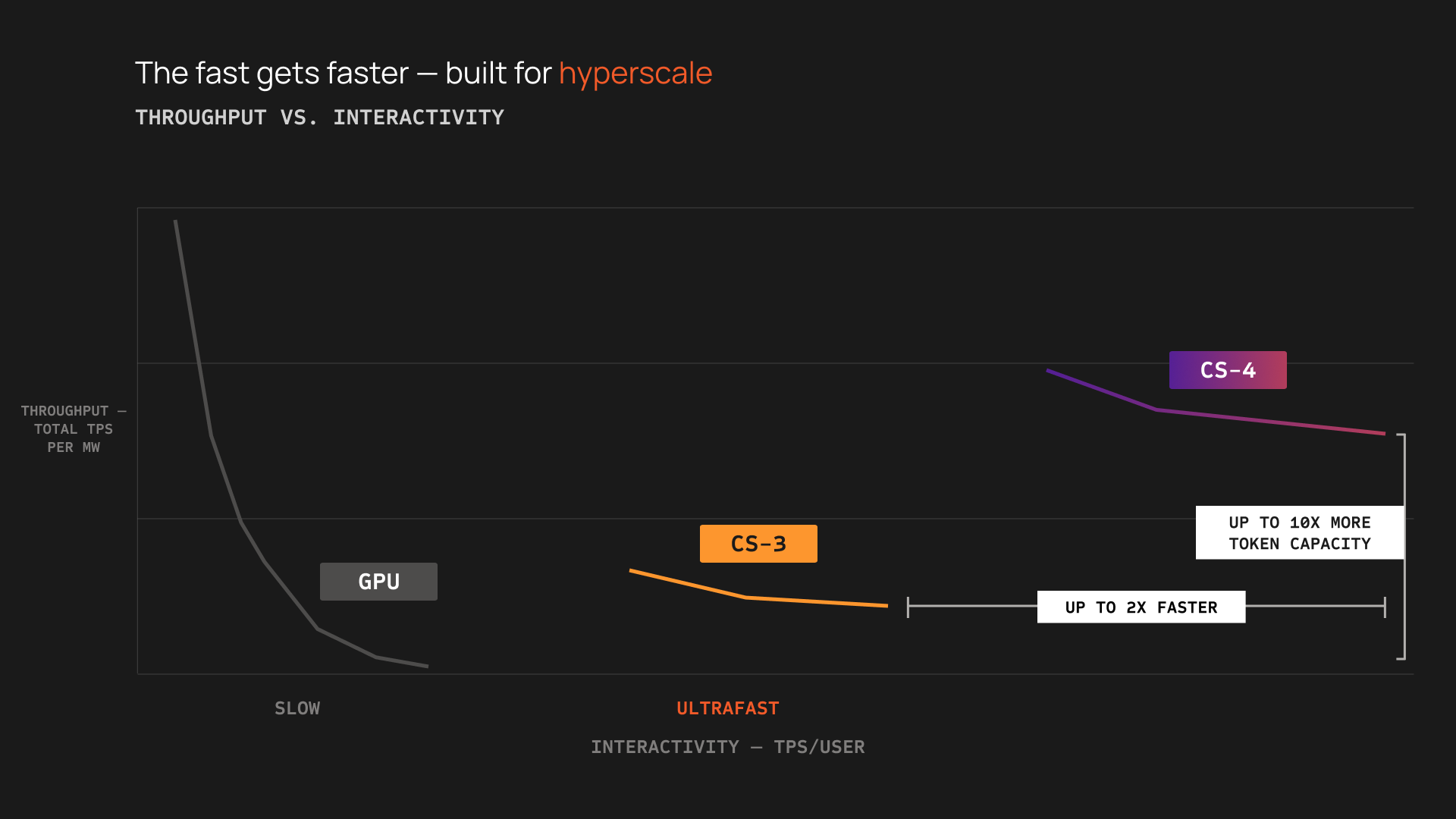
I'm pretty sure Cerebras has a confidentiality agreement with OpenAI, and this press release was carefully constructed to avoid leaking details about the model weights. For example, the graph of tokens per second vs. tokens per second per user doesn't have any numbers that would allow you to translate between the two. (And in any case the relationship depends on the model.)
Which I think makes it feasible to approximate activation from CS-4 tokens per second per user.
This was also interesting: "CS-4 delivers more than 1,000 tokens per second on models exceeding 10 trillion parameters." Was it known that there were 10 trillion parameter models in use?
I think the frontier providers keep the size of their models carefully hidden.
> According to FT, industry estimates say Anthropic's most advanced Mythos 5 has about 8 trillion parameters and Fable 5 about 5 trillion
https://www.reuters.com/technology/bytedance-targets-mega-ai...
I believe this report has confused Opus (which is known to be around 5T) and Fable.
Other reports say 10T. See for example https://eu.36kr.com/en/p/3760679047267075?ref=explainx where Musk talks about the models being trained on Colossus2
5T for Opus feels quite high though. DeepSeek V4 Pro is a mere 1.6T and often described as a match with Opus in overall quality. Even the largest open models in common use are around 2.8T.
It's not. Idk about who has more T's but, unfortunately, DS4 pro is not a match to Opus, at least not Opus 4.8.
The difference is very visible in long tail applications. Exactly where you'd expect parameter count to matter.
There is nothing to say for example a 1 Quadrillion parameter model will be vastly more intelligent than current SOTA especially since new training data is largely synthetic today
I think there is some merit in that smaller models cannot memorize so much of the training data, i.e. that they are less likely to do copyright infringement, and by analogy not having memorized SDK / API surfaces that have since changed from the training data
You have to rely on it to a certain level for agentic/coding work, presuming that's the general subject we're talking about here... For instance I recently encountered a project where it would have been a lot worse if the LLM didn't already know "what is" xterm.js and a bunch of its associated npm-related/node related software. If it was still smart but had to google and find results for everything it would have been a lot more time consuming and risked sending it down a wrong path.
at the same time, search may find newer or better alternatives, and you can always specify specific technologies you want to use, I typically do this when starting a new project
But these labs distill off the larger models. Both officially at the labs with the big ones, and unofficially. We need the giant models to get the smaller models.
The cost to train and infer that would be insane, even by today's standards.
Eg: https://www.reuters.com/technology/bytedance-targets-mega-ai...
That reports Mythos as 8T and Fable as 5T, but I think they mean Opus as 5T, which is widely known, eg: https://eu.36kr.com/en/p/3760679047267075?ref=explainx
Both Grok and Bytedance are training 10T models.
Honestly if Opus is 5T parameters while being matched by the biggest open models that are at least twice smaller, it would mean that the US is already behind China in the AI race, despite a significant edge in compute.
For example I regularly do Fable+Opus agentic coding runs over 24 hours without intervention.
I think I've had GLM do a run that was a few hours. That's the closest I've had an open model come on that kind of work.
That would be extremely surprising and a massive blunder by Anthropic in model design architecture ... which I highly doubt to be the case.
The long tail of tasks and queries is where you see the difference.
This assumption is likely what has led to the erroneous failure.
Enterprise compute per rack has scaled multiple fold in the last 3-5 years. Alongside the training efficiency gains & datacenter scale increases, even 50T+ is well within reach at the top end.
And there is, of course, the educated guesses about what WSE-4 will be, one being adding a LOT of stacked SRAM or DRAM to tip the balance towards memory (which could also be done by having a few different tile designs with various configurations of compute and memory capacity). I am curious about which way they'll go.
How about in a month or so when you have to run a slightly different workload?
In fact both of them, actually Amazon too, invest in their own inference hardware and owns the stack.
You can't possibly think that these companies will keep shelling 50-100B per year in hardware alone where 60%+ is margin for Nvidia and not invest there.
If it's patents that are the problem then presumably all these large semiconductor companies have defensive parent portfolios.
It would be a breach of contract not a copyright issue.
1. https://www.youtube.com/watch?v=3MKRjt59hh4&pp=0gcJCRMMAYcqI...
NVLink is at gen9. they had a lot of teething problems and can codesign the hardware and software.
in the name of openness (AMD's only """weapon"""), the UALink spec is a hodgepodge of corporate opinions with very different implementations (looking at you, Broadcom). at spec version 1 (in hardware).
I wish them good luck as I really like AMD, but they compete no more on this than Lambo vs Bugatti.
If they could launch Qwen 27b or Deepseek Flash that would be amazing.
Oops did they just out GPT-5.6 sol’s parameter count?
If Fable turns out to be a 10T or 20T model, there is little to boast vs Kimi at 3T. But the opposite is true: if Fable were to be e.g. a 500B model, that would show how far ahead they are from the open models. This isn't likely to be the case ...
I’ve got sone bad news about Federal Express.
For a charity? Assuring donors that funds are being managed appropriately.
For Anthropic? No benefit at all.
Turns out "transparency" is like "weight" or "velocity" in that it has no intrinsic value, and can be positive or negative depending on context.
It seems it takes some time to run a new model on all the benchies, not sure they run all models on all of them either
> CS-4 delivers more than 1,000 tokens per second on models exceeding 10 trillion parameters
Wow!
It'll all be as cheap as DeepSeek was before the price hike. And, it'll become more and more realistic to run near-frontier intelligence on personal devices.
I'm honestly baffled they were not acquired by somebody else (sorry AMD).
The absolute worst market time to etch a model to a chip is right now (very rapid iteration). There is no scenario where they can keep up. The Taalas approach will be viewed as comically foolish within just a few years.
Cerebras will win in terms of approach.
It's 1998: hey, I can drastically speed up your web service, let's etch it right to silicon.
Qwwen3.5 122b was released 6 months ago and is still best in class overall 100-140 B param model.
....
:T
Considering the 8B model uses 53 billion transistors, that's 6.625 transistors per parameter.
Assuming they can get it down to 3 (somehow), that's still 300 transistors, or 5.565 RX 9070s.
https://www.techpowerup.com/gpu-specs/radeon-rx-9070.c4250
You're looking at
1) waiting for another 3-5 generations of transistor improvements before it can fit into a single conventional chip, or
2) another generation before getting a monster of a chip (1000+ mm^2), and prices for flawless etching scale quadraticly (likely $1000+ for manufacturing costs alone).
Could happen, but it's a long shot for a market that could be satiated by specialized accelerators.
What costs are you talking about and why would them be a problem?
If it is the price: «Kharya says it costs 100x as much to train a model then to get a customize HC chip in reasonable volumes from Taalas» ( https://www.nextplatform.com/compute/2026/02/19/taalas-etche... ).
That is thinking about an LLM (logical) producer and server. For mass production, the costs go down. And in the case of a ~100b model as the poster mentioned, they would be just single PCI cards with 5 or 6 HC2 chips: doable and practical.
I see more potential problems in the positioning of the SRAM - but not a real problem given that excellent team.
To get a proper idea of the costs the architecture of the HC2 will have to be clearer.
I distinctly remember 32-bit/33 MHz PCI accelerator cards for SSL being a real thing (for use on OpenBSD or FreeBSD), in an era when something like a single core 700 MHz Pentium 3 1U system was a relatively powerful individual bare metal httpd box.
http://www.aster.si/partnerji/compaq/atalla/axl200.html
The CPU load of doing a lot of SSL purely in software was a problem in terms of scaling things up, so this was one attempt at a (very short lived) solution. Note that this predated TLS1.0.
Slightly disagree. It really depends on the price-point at which they can do that etching. ~1k usd / ~30B model in a hdd-sized case that fits on your desk? I'd buy one right now, even knowing that I'm "stuck" with whatever model of the day is.
> From the moment a previously unseen model is received, it can be realized in hardware in only two months ( https://taalas.com/the-path-to-ubiquitous-ai/ )
Yes, please!
There's a bit of a ticking time bomb there, something that a Taalas-like architecture can clearly resolve.
We can have that discussion now: sounds like that would kill OpenAI and Anthropic
Stack on top of that the fact that diffusion based models like the ones made by Inception Labs are far faster and more efficient than autoregressive LLMs and have an even higher ceiling of optimization (single step path prediction via model distillation versus 50 step denoise is currently an active area for image diffusion)
The human brain is soon neither going to be more powerful nor energy efficient than the stuff we use to run AI.
GPUs really aren't that great for AI. They just happen to be the best chips we have in mass production right now for this work load, and it takes time to field new designs. Basically every chip engineer on the planet is working on this right now.
If AI tends to be something used mainly in ideation and development, which is how a lot of people use it today, then once consumer hardware gets good enough you could see a bunch of the current data centre workloads move onto consumer devices.
But if AI starts being used more in repeatable, operational workloads I think it makes sense to have significant cloud infrastructure for it. TBH I haven't seen much of this, and I've been skeptical about people using agents for much of anything when it can be done with just software. But we are starting to see more of this kind of workload, like the taggable Claude in your slack etc that people seem to really love.
He claims that GPU depreciation/obsoletion is much faster than hyperscalers are assuming because new chips will be much better. He's being proved wrong right now because H200 rental prices have been claiming for the last 8 month despite B200 having 10-20x better inference efficiency.[0]
The logic is fundamentally flawed in my opinion. Let's use future Nvidia chips being much better optimized for LLMs for example.
New Nvidia chips 10x better than H200 --> data centers buy a lot --> Nvidia profits a lot.
New Nvidia chips 10x better than H200 --> data centers don't buy --> no faster than expected obsoletion.
In other words, the very act of buying many new Nvidia GPUs would be the event that causes faster than expected obsoletion. Yet, if you don't buy those new Nvidia GPUs, then there is no faster than expected obsoletion.
We also live in a world where there is competition. If Amazon doesn't buy but Microsoft does, suddenly Microsoft can offer better $/token prices.
2. You’re missing the “New Nvidia chips 10x B200, compute requirement grows less than 10*software improvements YoY -> buy less Nvidia.” Valuations are based on forward projections (>1T annual for NVDA) which can be revised down leading to a drop in valuation.
> If Amazon doesn't buy but Microsoft does
The big 3 all have their own proprietary accelerators. Meta is buying TPUs as well for now.
I would bet Nvidia’s major customers in 2 years are neoclouds and it seems that Jensen is making the same bet.
2. Jevons Paradox. More efficiency should lead to bigger models, faster inference, and more total tokens.
3. By all accounts, Trainium and Maia and Meta’s internal chip are struggling to keep up with Nvidia. That’s why they order as many Nvidia chips as possible. They’re not giving up but it isn’t as easy as buying stock Arm cores and taking them to TSMC.
Neoclouds may very well be Nvidia’s biggest customers and this probably what Nvidia wants.
2. Jevon’s paradox is about total consumption, not margins. Valuations are about margins (and their projections). Many coal mine owners went bust despite increased total coal consumption.
3. Source? Gemini for example is 70% on TPU. I have yet to see data on Maia-300 beyond Microsoft PR. Remember it doesn’t have to be better it has to be more cost efficient. The overwhelming majority of inference spend does not care if token output is 20% slower if it is 50% cheaper.
> Neoclouds may very well be Nvidia’s biggest customers and this probably what Nvidia wants.
What Nvidia needs. Whether neoclouds can stay competitive vs hyperscalers paying Nvidia tax is far from clear, particularly when inference margins compress.
2. Total consumption drives more demand for the already supply constrained hardware. Can AI hardware market go bust? Sure it can. But being early is the same as being wrong in the investment market. When do you predict the bust to be?
3. Google, Amazon, Microsoft, Meta are all buying as many Nvidia GPUs as they possibly can. The biggest tell on how Nvidia is doing is that their share in inference has increased despite the increase in competition: https://archive.md/CKP0N. So while competition is getting bigger and bigger because the overall pie is getting exponentially bigger, Nvidia's growth is still higher than average.
Some other sources:
https://www.businessinsider.com/amazon-nvidia-aws-ai-chip-do...
https://www.businessinsider.com/startups-amazon-ai-chips-les...
Burry’s main argument is depreciation is being understated and the capex vintages will not be paid off before they are essentially useless. This can happen whether or not aux is reused.
> Total consumption drives more demand for the already supply constrained hardware.
Demand is the wrong metric.
Only number that matters is whether AI attributable revenue will be sufficient to pay back enough of each successive capex vintage (e.g. 750B this year, 1T next year, 1.2T in 2028) so that hyperscalers and neoclouds can either self-fund or continue to issue debt as bond markets are already straining and tax-payer backed sovereign debt is providing a high baseline. Otherwise they downgrade capex projections and the bubble pops.
Expensive compute needs expensive inference to justify 30-40B/year/GW of compute. There are many reasons why frontier API pricing which is what the industry is based on may not persist. It is also almost certainly the case that 2026 is the worst year of supply and demand mismatch to allow for 80%+ margins. HBF next year has the potential to single handedly pop the DRAM spot bubble.
> Can AI hardware market go bust? Sure it can.
This is the bear thesis. It is not that AI will crash or be useless.
> But being early is the same as being wrong in the investment market. When do you predict the bust to be?
Q4 27-Q2 28 is when the bill becomes due at the latest. There are sufficient financial levers left to buy time without returns until then.
> Google, Amazon, Microsoft, Meta are all buying as many Nvidia GPUs as they possibly can.
All of these companies have rock solid revenue streams and can easily swallow 500B of capex devaluation over time. Their buying of Nvidia today is not necessarily the indicator you are implying as there are strong competitive reasons to make the game more expensive for everyone else.
Burry’s main argument is depreciation is being understated and the capex vintages will not be paid off before they are essentially useless. This can happen whether or not aux is reused.
The rest of your argument centers around whether AI growth will meet the cap ex expenses. I don't see anything new in it.
HBF next year has the potential to single handedly pop the DRAM spot bubble.
In the scenario, engineering everything becomes so easy - so why not optimize everything? every component, every product, every system?
And maybe llm's could invent. So even more to simulate. And simulation is inherently compute-heavy.
So unless there are some other bottlenecks, we'll use a lot of simulation servers.
In that 5+ year timeline, the compute per watt could change by three orders of magnitude.
GPUs are to LLMs what CPUs are to gaming — not a good fit.
If you want three orders of magnitude improvement, you probably need to find two of those orders of magnitude somewhere else: process improvements, different ALU design, model architecture changes, etc.
A rough analogy would be if the first generation of ISP's spent billions on dial-up exchanges, when fibre could be invented next year.
Why? Make your case.
There exist other AI accelerators (TPUs, ASICs) that perfectly exceed the throughput that LLMs need to scale as well. But the true solution is more software optimizations. There's a tiny handful of them but more needs to be discovered so that we can reduce building hundreds of more data centers as the alternatives mature.
As better software becomes more useful for the alternative AI hardware for developers with LLMs running efficiently you then would have more choices of hardware to run your LLMs on rather than just only GPUs.
Unlimited.
What has been the limit to electricity demand globally?
Unlimited.
We can't get enough and never will. Costs have to become pretty severe to turn back the demand as well.
https://openrouter.ai/rankings#top-models
And their market share sits at around 16-20%.
At 75.3 trillion tokens for the week ending 10 Aug 2026, that means that up to 450 trillion tokens were plausibly demanded by the whole market for that week.
My take: At max saturation, each person on earth could have their demands satiated by an average of 16 agents running concurrently. Sometimes more, often times less, but the average would likely be at 16.
At 200 tokens/second for each agent, that would mean 15.48288 quintillion tokens per week.
We're currently at about 0.00290643601% of the calculated demand ceiling.
Even if the demand limit per person is just 1 agent at 50 tokens/second, the current demand's still 0.186011905% of the theoretical ceiling.
They're typically not built where you want housing, and the buildings are distinctly the wrong shape.
If you can't use the power infrastructure profitably my next thought would be warehousing.
But also... we've seen a pretty continually increasing demand for compute. Even if AI busts a bit (or becomes a bit more efficient) I bet most data centres stay data centres, just less profitable ones.
> built on both the insurmountable trillions of debt, and the assumption that only GPUs are all we need to continue scaling.
Insurmountable according to whom? And who assume that only GPUs are all we need to continue scaling? Google, Amazon, Microsoft, Meta and OpenAI, all have or plan custom non-GPU AI chips. Do they plan to use them not for scaling?
What's the point of 1000tok/s if you have to do prefill on every agentic turn which at 100k depth would make it 1.5 min latency every turn?
44GB on-chip-sram * 3 chips. Per chip: 43.2 PB/s memory access + 53.5 PB/s on-chip fabric bandwidth + 2.4 Tbits/s "IO" bandwidth (I think that means their RoCE v2 RDMA over Ethernet interface).
I suspect there might be a certain amount of customization for how much RAM they attach when you order it.
This is 1/3rd blackwells nvlink c2c bandwidth already. Not too bad. We can make KV cache offload work with that I suppose.
If magically KV cache was not an issue, pipeline parallelism on cerebras can be quite pleasant. As for the KV cache offload, I have hopes their CPO solution they're trying with that canadian company ends up bearing fruit.
All or a vast majority of of the cerebras manufacturing capacity was going to a few companies that aren't publicly available inference providers on openrouter, for their own internal use.
or
The asking price of the S-3, no matter how speedy it might be, for small/medium size customers made it economically prohibitive to purchase and use to sell public inference vs. buying more common nvidia b200 or whatever.
imo the issue is that most openrouter demand is inauthentic activity (things that anthropic and openai models will refuse to do like pretend to not be bots when interacting with humans)
So I plugged 288 trillion tokens/month (OpenRouter's current rate), 500 billion MoE model average, and the math comes out to be around 620 B200 GPUs minimum.
So basically, OpenRouter's volume must be absolutely tiny compared to the volume hyperscalers are getting.
[1] https://x.com/ren_stocks/status/2056946641815396718?s=20
A Ferrari can seat up to 4 people[0], which is about the same as the average car. Capacity doesn't change much.
Meanwhile, a bus/subway system is meant to support millions of people. Tokyo's metro has to support up to 37 million people. You can't do that with Ferraris.
Can you imagine something radiating that much energy into a space in your home?
This is far beyond the practical maximums of like 10 to 15kW per 44U cabinet front to rear air cooling for 'regular' rackmount server stuff.
More realistically, you need much more cooling water.
if you have the money as an "individual user" to purchase one of their racks... save your money and retire.
* Actually they sent out an email claiming they already have it, but I don't seem to have access, they're promising to release it to the "shared tier" any day now.
Now that this hypothetical person has retired, what are they gonna do all day? Just sit on the beach and drink Mai Tais? If that's what they wanna do, sure, but nerds gonna nerd, and if I had that kind of money to retire on, I'd totally buy some ridiculously expensive AI box for fun.
there is an extensive and complicated cooling system that permeates the wafer. some of the cores are completely turned off because they fail qc (see the tsmc logo) if all of their neighbors have been going at full bore the thermal differential can cause stress fractures if the cooling system suddenly fails.
I understand that Cerebras has competition, but this bodes even more poorly for Nvidia for inference. Nvidia may still have a role to play for training, however.
Nvidia's extreme margin is the opportunity for OpenAI's cost reduction. Buying Cerebras would pay for itself and they should take all of its future production (after filling required contracts).
Right now China's models have no silicon moat. Cerebras as a drastic speed-up / cost-reduction potential, can assist in building a competitive moat. And every time a Cerebras pops up, OpenAI or Anthropic should eat them if at all possible.
There's no stand-alone frontier AI company of great scale in the near future that doesn't have a large silicon advantage in-house. Apple knew it in smartphones, Google figured it out a long time ago as well.
OpenAI is partnering with Cerebras while simultaneously investing in their own silicon play. Hedged bets.
After sitting thru their keynote today, it makes sense. The main throughput speedups they tout are an obvious evolution of the GPU that all companies will be building in the next year. Wafer-scale interconnected memory and compute is just going to beat out mountains of network cabling any day on both cost and performance metrics.
Did nobody proofread this?
It’s still incredibly obvious.
A single TSMC wafer contains 60 to 65 B200s, assuming 70% yields that's 40ish wafers per die.
Cerebras cannot redefine wafer economics.
I guess you'd need a DOZEN(s) of these to host a large model with long context KV caches?
GLM 4.7 (December 2025) not 5 (Feb) 5.1 (April) or 5.2 (June). 5.3 (4 days ago) is, to be fair, not open weights yet... but there's a lot since 4.7.
Kimi K2.7 (April) not K2.7-code (June) or K3 (July).
Gemma 4 (April), Llama (April), and gpt-oss (August 2025) are up to date, but old (for models).
Meanwhile the closed source GPT 5.6 sol is up to date (June)...
Should potential purchasers take away from this that they're not going to be able to run recent models unless they front the cost of developing software or something?
But even an enterprise is going to care about the difference between "we can run the model we want with support from the manufacturer" and "we have to purchase the product, and then spend another 6 figure sum having developers port a recent model to the product to use it".
A single AI server with a mere 8 GPUs from Nvidia is already mid 6 digits. A rack system from Nvidia is mid 7 digits.
There’s some info out there that suggests the CS1 had an 8 digits price tag, so it wouldn’t be surprising to see that here.