Edit:
Looks like the author only has a reference to a subset of the originals on archive.org. There's tons more for more rural parts of SD you can find them on the city website:
https://www.sandiego.gov/digitalarchives/film-audio/street-v...
The matrix of vehicles is my favorite part. If you drive down these same streets today it's a sea of black, white and grey.
You'll be happy to know that Les Girls is still there today, advertising burlesque, go go dancers and "full nude". They finally replaced the sign earlier this year, but it still looks very much the same.
Les Girls is the feature of a fascinating podcast, too: https://www.kpbs.org/podcasts/stripper-energy
I deal with these owners EVERY DAY who would rather sit on crappy buildings and land because why not, it costs them nothing. They've owned forever. Literally TODAY I had an offer rejected from a Seller that would have yielded 80 units of affordable housing in an area with $150k median income, delivering completion in 2028-2029.
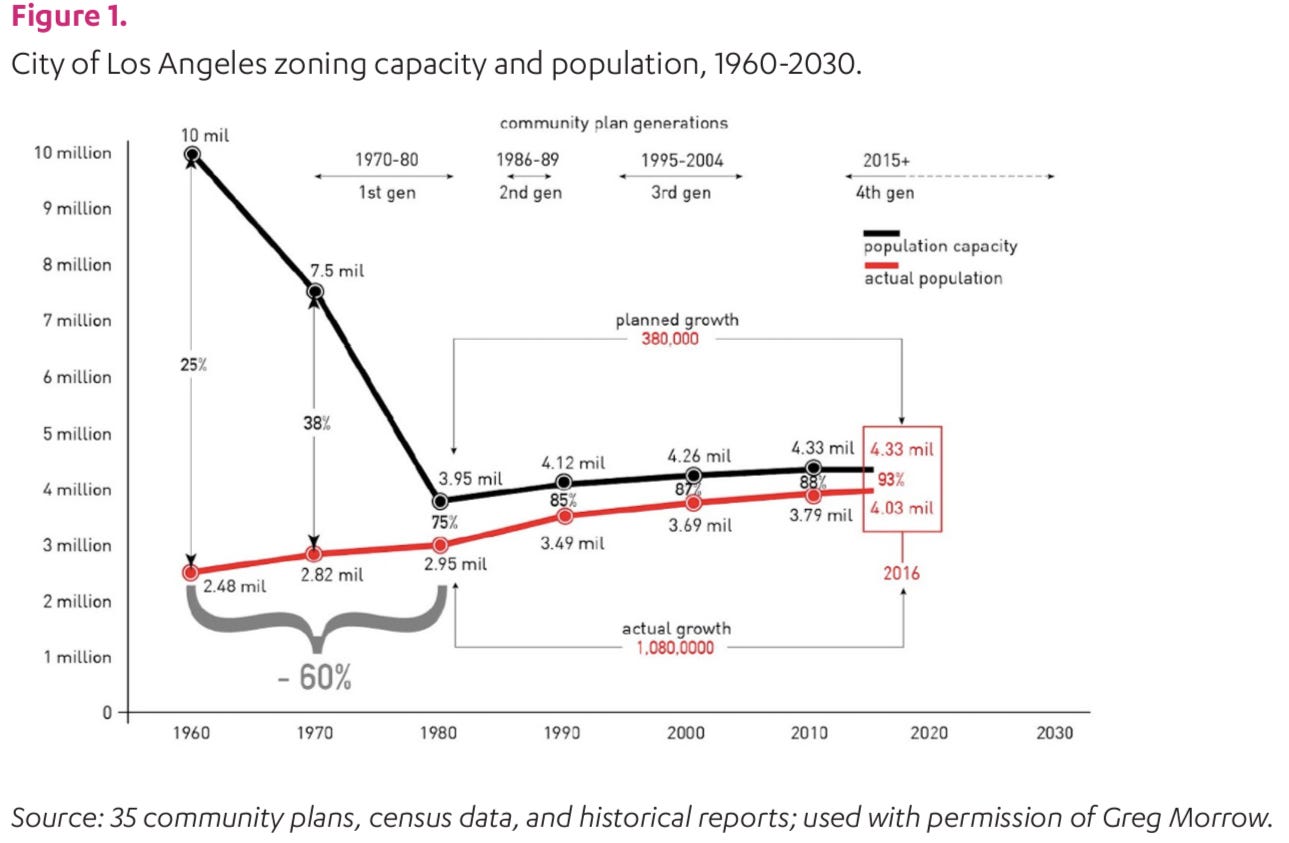
Have a look at this graph: https://substackcdn.com/image/fetch/https%3A%2F%2Fsubstack-p...
You can see how even with prop 13, even with various RSO ordinances, even with red tape, even with building code requirements, the demand for development has always been enough to build to the limits of what has been allowed through zoning, ever since cities like LA were widely downzoned in response to redlining being made illegal in the early 1970s and succeeding zoning plans.
Zoning limits what and how much is permitted. Prop 13 changes the economics and greatly reduces churn and supply, both for redevelopment and migration.
Prop 13 takes the normal supply problems introduced by zoning and turbocharges them.
There's a lot of low-density sprawl in San Diego county which makes effective transit difficult, and because you have to drive everywhere, sentiment trends anti-bicycle. The previous CEO of SANDAG tried to push a mobility-centric vision but left because of intense pushback from folks who wanted more funding for roads and freeways, rather than transit and bike paths.
Check out Disneyland. There was nothing else there when it opened in 1955
[0]: https://en.wikipedia.org/wiki/Guasti%2C_California
[1]: https://www.google.com/maps/place/Guasti,+Ontario,+CA+91761/
New families with some money spend too much income buying house.
Kids move out, parents get old and don't get out as much. Don't keep up the house, because they need to retire.
Sell house that's only attractive to lower income. Low income statistics take over the area.
Nearby businesses close from everything related to low income statistics.
Repeat with new families and newly built houses at edge of city, letting the interior rot.
Like a slime mold.
There was even a time when very large highrises were being constructed e.g. Wilshire Blvd's condo canyon. But that was also seen as a blight and quickly stopped in its tracks from expanding beyond the immediate arterial frontage. All hell would surely break loose if you allowed for student housing to be built on the eastern edge of UCLA instead of contained in the sliver of land between the school and veterans cemetery I guess. Unfortunately for the student body, the school is shoehorned in between two prestigious country clubs, and it is clear where priorities lay among local leadership.
Zoning in the 70s was more a response to (1) homeownership property value protection (2) nimbys being given the power to block projects like they still do today, especially in highly "progressive" cities. The more progressive, the harder to build (3) people claiming expansion was bad for the environment.
??? Zoning is the mechanism to disallow infill, it can't come in response to it. The book "The Color of Law" by Richard Rothstein covers how zoning as used as a new tool for racial exclusion in its third chapter. Indeed, modern socal remains a highly segregated area thanks to zoning decisions that ensure working class people, who are predominantly nonwhite, will find no suitable housing they might afford in the various lily white strongholds.
In scanning some slides from the 1970s, I was struck by the colors of the pants! Bright! Stripes! Fun! I sew shirts and gravitate towards bright prints, and everything tends to stand out because clothing in general doesn't seem as varied today.
EDIT - Found many articles along the same lines, some even with the same images. This isn't the original one that I was thinking about, but it is equivalent
By my reading of the map, it means that that Midway Rising will cover the Salvation Army store and everything west of it between Sports Arena and Kurtz St (including the current parking lots).
Of course, if/when Midway Rising does happen, it'll probably spark future developments..
I actually don't really think cities should be like that though. They should evolve more freely. No point in trying to explain it though.
My parents grew up around this time and a lot of it still looked liked this when I was a kid in the 90s.
I always wanted to move back to this San Diego, but it no longer exists. Appreciate whoever did this work.
Torrey Pines area definitely looks the most different, mostly because of the growth of UCSD I'm thinking.
The nostalgia aside, that's $3.23/gallon today. Cheaper than today with our ongoing war, but same price as Nov 2020. At 20mpg that AMC gremlin was about as fuel efficient as our modern huge SUVs though.
Why was the chain called "Der Wienerschnitzel" and not "Das Wienerschnitzel". It is (was) a proper noun, but why the wrong article? (5:02)
A small part appears twice (from 8:51--9:06).
more cyclists than I see in current streetview footage
Coca-Cola delivery vans where yellow?
Yeah. Too bad you weren't able to choose if you would like your gasoline with or without lead yet.
Still possible in some places. Especially cities with large numbers of retirees.
I used a full-service optional Shell station in Las Vegas last year. Unlike when I was young, full-service didn't mean in increase in the price of gas.
50 years early to the "gooning" trend, I see...