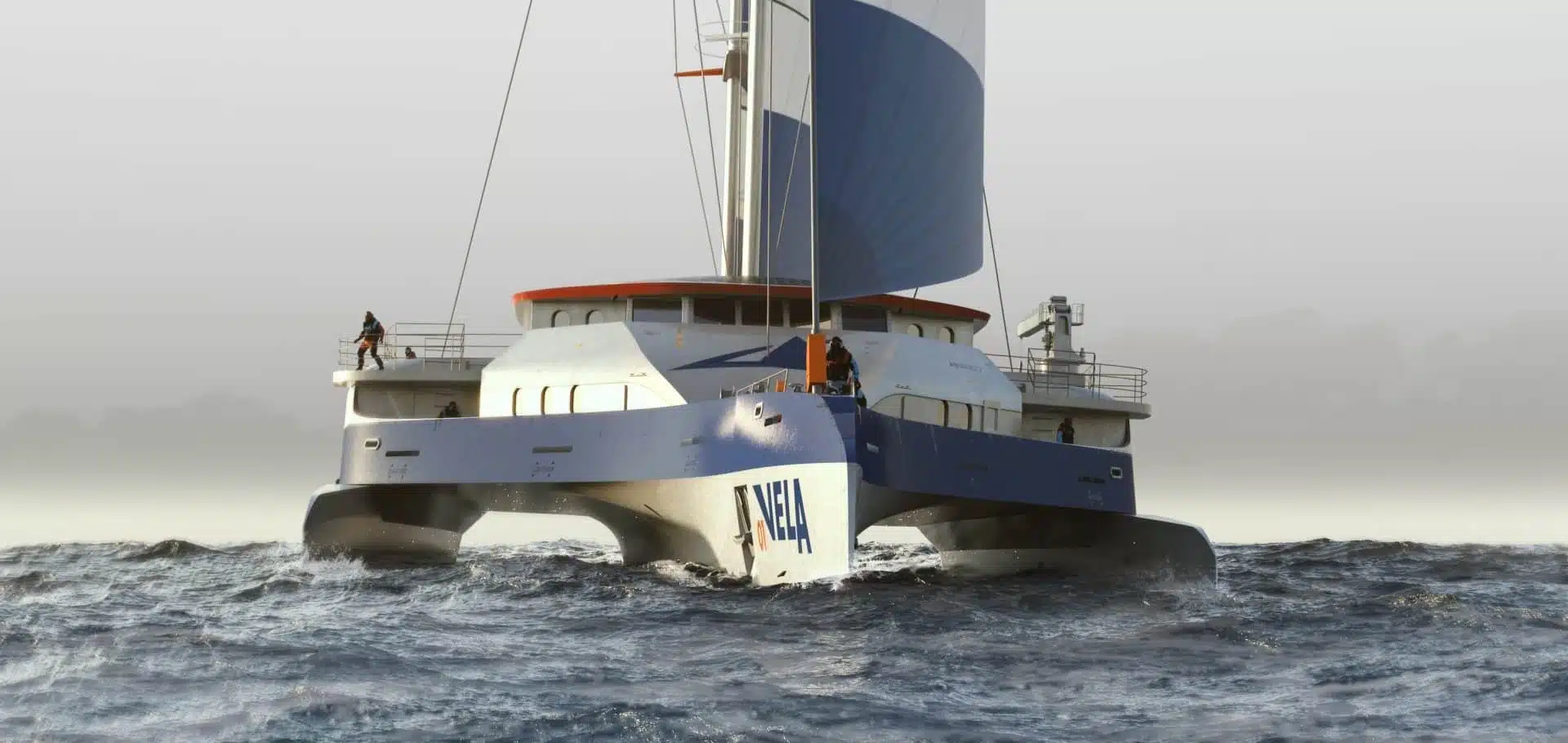
Not to take anything away from this (it's great), but for reference, an average vessel in Maersk's fleet can carry about 100,000 metric tons so you'd need about 250 of these to replace a single container ship.
Not sure why the article decided to compare cargo capacity of a airplane with the length of a container ship, but alas.
Hawaii is looking at running some next year.
https://www.sfgate.com/hawaii/article/hawaii-electric-airpla...
I'd expect ferries and/or small cargo ships to be an attractive option if allowed.
The challenge when moving goods via ocean vessel is that everything takes _a long_ time. Loading and unloading the vessel can take days. Transit is weeks. Unloading the vessel takes days.
You have 2 options now: air freight which is crazy expensive but gets it there in a few days max or ocean freight which is relatively cheap but might take weeks. If you can cut out vessel loading/unloading you save at least a week.
Air freight is also an odd comparison since it's usually time-sensitive and/or pricey ($100+ per pound).
What I don't understand is that they are talking about running it trans-Atlantic. Taking longer than a normal container ship, while taking less cargo. You save on fuel, but surely the crew costs must be eating up all those savings. And you're not really faster. Unless the plan is to go point-to-point between smaller harbors, making up any lost time by saving on cargo handling time
A lot of containers take a small-ship trip after the big-ship one.
Because journalism is plagued by innumeracy. Same reason the author is talking about the length of cargo ships instead of the volume.
We’re talking here about a fairly large crew that will transport a small amount of cargo while taking a really long time. On top of that, these aren’t container ship so loading/unloading will take a long time. There is no economic case here.
The only way you can make this somewhat work is by selling the aesthetic/story. E.g.: this coffee was shipped by sailboat. But even then, notice how every company linked in the article of another commenter aren’t actually operating anymore…
Until fuel prices change for the long-term and/or emissions regulations have an order of magnitude uptick as well as covering far more than sulfur (see IMO 2020 https://en.wikipedia.org/wiki/MARPOL_73/78#IMO_2020 ), there will be zero economic incentive to use wind-power over diesel/bunker-fuel power.
And no, any advantages of docking at smaller ports are defeated by those ports having less land-transit access and we already have fleets of (smaller) cargo vessels serving these ports at insanely low $/ton/mile rates.
Just like farms, all of the economics point to larger vessels, larger ports, and operating entity consolidation. See "The Box" by Marc Levinson https://a.co/d/0gtBkWwt or watch a few "What's Going On With Shipping" https://www.youtube.com/@wgowshipping videos.
It will take some sort of global political or environmental catastrophic externality to even budge, let alone change, the status quo.
The industrial scale-up just happened quickly since the same tech could be leveraged from chip manufacturing for solar and composite construction from airplanes for wind turbines.
There's no similar performance potential for wind-powered vessels over combustion-powered vessels that can be "scaled-up" and, if need be, we can make green fuel from raw materials and still economically out-perform wind vessels.
To be accurate, they bought the startup. But still: they didn't wait for the automotive company to come up with a e cargo van.
We already have sailing sports where people race all kinds of wind-powered vessels, and they push the envelope of tech development, just like F1 and the car industry.
Also rich people love this sort of thing. Give them something to do with all that money that has some sort of chance of improving things.
Check this photo:
https://vela-transport.com/wp-content/uploads/2025/03/FACE07...
A mid sized cargo ship has a 50_000Kw engine. A mid sized offshore wind turbine makes 1_000_000Kw. So depending on which way the wind is blowing it could work. Put a diesel electric drive and a full sized engine then use the wind turbine to see how much it could reduce fuel use. I was even having fun dreaming about the incidentals. how hard it would be to build a folding/quick assembly mechanism for the turbine to make harbor/bridge/crane access problems go away. could we duel purpose the wind turbine boom as a crane boom. Would a vertical turbine make sense?
While reading up on wind turbines I ran across the depressing story of the small ferry Hornblower Hybrid. A lot of hype on how environmentally friendly it was in 2008 when it was retrofitted with two vertical turbines. But my first though was "those turbines look awful small" and they are, the best they could do is power the lights not the boat itself. The boat itself was retro fitted in 2024 and lost it's electric drive. https://en.wikipedia.org/wiki/Hornblower_Hybrid
I bet even if it would work from an energy point of view, the extra complexity of the system would make it more expensive than a straight diesel ship from an operations and maintenance point of view.
A generator and a propeller would only add weight and complexity for a loss in efficiency.
There have also been ships with vertical turbines mechanically coupled to propellers. But you can't build them very tall, so you lose the best winds. Those haven't been good enough in the past.
The only real footage I can find is a construction video from a year ago: https://www.instagram.com/reel/DL9CSLdtkaP/
Well, unless you count pre-motor cargo ships of course, those were the only option for centuries.
"Slow steaming" is already in use and has some dramatic impacts on fuel use.
The limit seems to be "hotel loads" i.e. constant loads needed for crew, but the sailboat will have those as well and not spread over as much cargo.
It's entirely possible that a sail boat that follows the wind might be higher carbon per cargo kg than a giant standard ship going very slowly directly to the port.
Check of oil prices same day article was published:
WTI $73.51/bbl BRENT $77.57/bbl MURBAN: $70.46/bbl
The article seemed a bit light on actually how it's been powered.
My initial assumption was that it's just going to harvest wind out of the air to power electric turbines since there's probably so much wind at the sea so much of the time.
But there's a quote in the article that says we're going with the wind, and not in a straight line.
Why is it always like this ?
"Slight improvement to be delivered in beta in a 5 years for limited users at premium prices.
Meanwhile, the latest catastrophe auto-updated 4 times while you were reading."
But whatever reduces the use of "bunker fuel" which is the most toxic vile fuel around (cruise ships use it too)
https://www.economist.com/technology-quarterly/2005/09/17/sa...
The company recently went bankrupt, by the way. It turns out that gigantic container ships are already incredibly efficient.
International trade is wonderful, all this new tech we're drowning in is amazing, and- understand that every one of us will eventually die, hopefully passing on some positive influence to others along the way, and that it turns out opting for the new car, the big climate-controlled house, the weekly/monthly/annual/still-too-frequent long-distance flights/drives, the new pocket computer every few years, the fancy unnecessarily-powerful laptop, the hours spent on all the man-child hobbies because we haven't outgrown our childhood insecurities, all this is an incredible waste compared to the meaning derived from healthy relationships with people within walking distance, tending the land we get our food from.
Ohh, a year previous PopSci talked about using the Magnus effect for wind turbine blades. https://archive.org/details/popular-science-1983-no.-8/mode/...
In any case, it's another gadget which "seems to have durable appeal to entrepreneurs and/or suckers."
Or most research and technological development requires years or generations of experimentation and failure before success. And every time, the creators and innovators are told they are wasting their time, suckers, look how many failures came before you, ...
Most research and technological development fail, and most of those which succeed in a technical sense end up being worse in a practical sense than other alternatives.
There are a lot of gadgets where "the creators and innovators are told they are wasting their time, suckers, look how many failures came before you" -- and the detractors were right.
The screw-propelled vehicle, after over a century of development, has slightly more success than the steam airplane because there is a niche use as amphirols. But for nearly every case it was designed for, caterpillar tracks, half-tracks, or even tires are better.
No matter how much R&D you put into it, it seems impossible that a roller ship like the Ernest Bazin will have commercial success. Ditto the gimbaled cabin design of the SS Bessemer, meant to stave off seasickness in the passengers.
Various gadgets lie on the border where they seem tantalizingly commercially realizable, like kites on container ships. That's where kooks and hucksters thrive.
I agree. So what? If you have a better way, you will no doubt be very, very successful and your name will be in history books.
But so far nobody has a better way. It follows that we cannot predict which R&D will fail to be developed or fail to be useful - otherwise we wouldn't have so many failures. And therefore the claim upthread, that they know now the future outcome of this research, is false.
"Or most SUCCCESSFUL research and technological development requires years or generations of experimentation and failure before success."
Most research and technological development fail, which is why creators and innovators may be told they are wasting their time by looking at well-traversed, almost certain dead ends in hopes of finding a new, long-overlooked path, rather than putting their efforts into R&D more likely to succeed.
We can absolutely predict that some R&D will fail to be useful - I mentioned a few. Here's another - a radium-powered reading lamp.