Maritime shipping is very efficient, and consists of a very small fraction of overall petroleum usage.
Road transportation uses about 20x as much fuel as ocean shipping, planes use about 2x as much, and trains about the same amount.
The typical rule of thumb is that about 40% of the energy in a barrel of petroleum is lost before it goes into your gas tank. And the two big factors are the energy required to do the refining and delivering the fuel from the refinery to the gas station. Shipping the crude from the oil field to the refinery is a factor, but a small one in comparison.
This 40% is the main reason why driving an EV emits less carbon than driving an equivalently sized gas vehicle even if you're topping up that EV with the dirtiest electricity you can find.
P.S. maritime shipping typically uses very dirty fuel. We'll probably notice the reduction in sulfur pollution more than the reduction in CO2.
P.P.S 3% of a very large number is still itself a large number, so it's still worth looking for solutions.
I’m pro EV by the way, I just want to understand your point better. Being able to go all the way to transportation using clean energy is an obvious benefit of EVs. The “dirty electricity” angle is less obvious to me.
In an ICE engine about 30% of the energy becomes motion. About 70% is heat.[2]
In other words electric motors are about 3 times more efficient than ICE.
[1] an interesting side effect of this is that in cold climates you can't just harvest waste heat to heat the cabin (or batteries. ) So you end up using some battery energy if you need heat.
[2] ICE motors vary in effeciency a lot. 20-30% is typical. The Carnot formula comes into play here.
[3] because there is so little heat generated, the cooling systems (EVs still have them) are much smaller. And simpler (for example, no fan, 'cause there's no heat when standing still.)
If you charge at home it gets less. If you have solar at home it approaches zero.
Yes, the cost of the car itself is a factor, but even there prices are dropping all the time.
>> when you can only take 10% as much fuel
effeciency makes all the difference when we discuss % of fuel. 90% of 100 mj is the same as 30% of 300 mj. So already the "fuel" can be 66% less. Generally though the raw amount of mj isn't a very important number. A better measure (which takes effeciency, and tank size into account) is "range". But even that is somewhat meaningless. At some point range is "enough". For daily commutes that may be 50 miles. For long-distance it might be 500 miles.
In only a very few cases would a pickup with 2000 mile range be more useful than one with 1000 mile range.
Plus you can also factor in maintenance costs. The cost of ownership of an ev, from a service and maintenance point of view is a lot lower.
[1] ymmv somewhat. Although electricity prices vary a lot, so do gas prices. The 50% saving (at worst) is a pretty good rule of thumb though.
The bio-fuel people at least make some kind of sense compared to fossil fuel "survivalists" - but again they're portrayed as just tree huggers!
Or just have a second stationary battery to store up the energy while you're away during the day.
Not generally, although some are. The UL certification will put you at the top end of the $100 - $200 / kWh range I mentioned. Eco-worthy and UZ are two brands with such certification.
Will Prowse reviews a bunch of these.
Where I stay 8 panels is a "small" system. I have 20. In summer that generates 85% of my household needs. (It would be 100% but I deliberately only got a very small 5kw battery.)
In winter it's less (mostly because of heating requirements). But I have space for some more panels, so I'm running the numbers. (I'm currently getting 16% return on capital spent, and there's a point of diminishing returns.)
Obviously ymmv. There are roof, and land, constraints. There are financial constraints etc. But being off-grid, or partially off grid, is very possible for a lot of folk.
If the world can afford to manufacture 100 million light vehicles a year it can afford to manufacture the solar panels to power them.
If there is such a marketing, then people relate to it because EVs are not suited for handling unpredictable situation. You got stuck in a ditch in the middle of nowhere at night, you loss all of your battery getting out of it, and now you are stuck. So you can't take it to unforgiving places.
EVs are great for boring commute that is it. I don't see it changing any time soon.
I find it interesting how you’re presenting that incredibly unlikely scenario as a serious objection to an EV when simply going off the road is a once in a lifetime or less situation for most drivers, much less precisely calibrating it so your vehicle is not damaged too much to be unusable but still needed a massive amount of power to get free.
That’s an interesting counterpoint to something which happens to thousands drivers every year: having a bad storm cause them to sit in lengthy lines waiting for fuel (this was weeks the last time I was in Florida) or, in colder weather, idling through a tank of gas while stuck waiting for ice to be cleared.
In my country, one don't have to go off road to get in that situation. Here I can never trust an EV like I trust an ICE for going to unfamiliar places.
I have said it multiple times, but it is just wishful thinking that humanity will behave differently/responsibly w.r.t disposal/recycle of batteries as EVs start replace ICEs on a global scale. I think it will be an even bigger problem than the current issue with green house gas emissions as the current generation appear to be greatly apologetic to the associated issues, as the past, generation were to the issues of ICE.
The circle of collective blindness repeats!
Aside from anything else, if you're in a ditch your car probably isn't drivable and needs towing somewhere to get fixed anyway. Whether you've used 100km of EV range trying and failing to get out of the ditch of 100km worth of fuel trying to get out of the ditch is irrelevant. If you need to use that much effort to get out of the ditch before realising it's a stupid plan that's not going to work and the correct solution is to call a tow truck, then you definitely shouldn't be driving that vehicle anyway.
It won't be efficient but neither is driving a few liters of fuel to someone from a gas station.
https://www.thecarexpert.co.uk/call-breakdown-provider-ev-ru...
Based on these average values I used, EVs fared slightly worse.
This was not factoring in costs of purchase or repairs etc. And all averages were taken off the internet so everything had to be taken with more than a grain of salt. But the outcome was nowhere near your statement of EV energy costing about half of the cost of gas for the driver.
I pay around $.12/kw and get 4 miles per kw. So my "energy" costs are $.03/mile. I have a Mazda cx50 as well, it gets about 20-22mpg, with the gas prices here in Seattle that's around $.30/mile. Even where gas is cheaper that's still $.20/mile. Literally 10x the cost to run a gas car vs an EV.
I'm honestly shocked at how many people have EVs and rely on charging stations. I mean, I think it's a low number, but the fact that it's more than zero is shocking to me.
I've got a hybrid now, at least.
But even if you can’t find any of those, L2 charging at stations is half as expensive as fast charging.
What actually matters is where extra generation occurs to handle the marginal new load of new electric vehicles.
Everyone fools themselves because they look at the current percentage of hydropower and think that is what powers their car - when it rarely is.
Well there's your problem. Try doing the same calculation with the average residential electricity cost. Most car use is for commutes after all, so most people can just charge their EV in their driveway every night.
Destination charging and rapid charging are notoriously expensive. It's a luxury product intended for a once-a-year road trip. It is not even remotely representative of your average charging cost. Street-side charging is slightly less excessive, but you're still paying a serious premium.
That does presume that those "most people" have a driveway where they can do charging. I.e., all apartment dwellers with cars in parking lots/garages (excluding those few that may have installed electrical plugs at each parking spot) are cut off, as are city dwellers without driveways who park on the street (or in another garage, again without electric hookups for charging).
Yes, eventually those garages and parking lots will likely include some form of "car charging" infrastructure, but until that happens, "most" is not as big of a percentage as that word makes it appear.
Maybe society can coordinate that? The CO2 being emitted isn't waiting
There are some other parameters to consider too. Stopping for fuel is not something I enjoyed. I can charge at home. You won’t have to stop to refuel in an EV unless you’re going a long way. If you’re going a long way the stop will be longer. Much worse.
You won’t service an EV much, that’s nice.
The silence is bliss.
Humans are like this about a lot of things, imagine what it was like before widespread universal literacy. Why are we teaching everybody to read? What are they going to do with that skill? Until you've tried it, the fact that your entire populace can read doesn't seem like it would make a big difference.
And yes, there are also EV owners who are unhappy, but they are much less common. In general, when I talk to EV owners they would not go back to ICE.
Yes, I hear the objections. But I also see communities overcoming those problems. I was in London a couple weeks ago, and I saw multiple EV's parked on the street being charged from the nearest lamppost. This in areas with little to no off-street parking.
I noticed in parking garages more and more charging points. And so on.
Yes, I imagine price does vary. But if the landlord in my office block puts in electric chargers then I expect we'd negotiate the price with him. He wants to keep tenants happy. We want to keep staff happy. I imagine cost of the actual electricity to the employee would be barely above municipal cost rate (if not below it.)
When it comes to charging availability, it's a problem that's pretty easy to solve. The difference in the last 5 years is remarkable. And it will continue to expand as demand picks up. And it can be solved by individuals with individual capital. So it can happen almost overnight.
My post wildfires NEM2 off peak rate for electricity is $.40/kWh. My Bolt gets 4.5 miles/kWh. That’s $.1125/mile.
If I were driving a Tesla it would be worse (my wife’s Tesla lies mercilessly about its range when full; it’s like Elon Musk recapitulates himself; real world it gets about 3.5 miles/kWh), and if I drove a Rivian it would be MUCH worse.
So, in California, it isn’t true at all (mostly because rate payers are funding PG&E’s liability) that the most efficient EVs are cheaper than a good mileage gas car. No where near a 2x advantage (it was better, but not nearly 50%, when I bought it, more like 90% of the gas cost). At no point has it ever been close to 50% cheaper for fuel in California (which, as it happens, sells by far the most EVs).
Generally speaking, I think EV proponents (like me!) should spend a lot less time promoting “it’s cheaper”. It is, in practice, cheaper, because maintenance is cheaper. But Americans don’t care about levelized costs, they care about the highest salience variable expenses, and trying to convince them to do otherwise is a losing argument.
And yes, I'm sure there are places where gas and electricity get closer together. In the US gas is mostly untaxed. So it's closer. Elsewhere the tax-cost of gas works in EVs favor. [1].
Also I think PG&E is perhaps not representative of electricity producers.
So sure, in your area, the finances only make sense if you factor in maintenance. And if gas prices remain stable. And if you don't have solar. But again, all these factors vary wildly in various places.
[1] in the long run these taxes will need to be made up elsewhere. So that's a temp saving. But I'm enjoying it while it lasts.
Filling the wagon today would cost me like 170 euro. Filling my xpeng happens overnight and is about 7-9 euro depending on grid pricing.
Negative externalities like pollution and climate change are not even priced in. Even if they were priced in, there are non-monetary factors that we could consider once in a while, but the conversation tends back to dollars.
Assuming you think price as a signal is the solution to dealing with those externalities, it doesn't matter what caused the price to be high.
How you account for the tax dollars received doesn't affect the pricing signal.
We have accounting systems to colour tax dollars. However that doesn't mean you can define cause and effect like you are attempting to do. Although I've no idea what we should do.
Not everyone is you.
You can recharge your car at home every night. At 2 in the morning.
You have conversion losses to generate motion but these are again substantially less than the conversion of chemical energy to motion that occurs inside a combustion engine. Powerplants+electric motors will have conversion efficiencies around 30%; internal combustion engines will have conversion efficiencies around 10%.
With the exception of some remote locations or emergency situations with backup generators, you are almost certainly not consuming a fuel that requires refining to generate electricity. If you're burning coal or gas, it's coming from much closer, and it's being transported in bulk to the powerplant. Trucks taking fuels to the local distribution centers and ultimately gas stations are by far the largest transportation energy expense for petrol.
In Australia power prices are often negative in the day due to solar and there's various variable rate plans you can get to take advantage (Australia dwarfs all other nations in per capita solar; even China is nowhere close per capita). I know workplaces that will actively encourage you to charge your car at work.
Power prices due to the excess solar keep falling - eg. 10% fall nationwide in July (middle of winter in Aus so not even near peak solar). https://www.theguardian.com/australia-news/2026/may/26/power...
For all the talk of 'solar can't replace fossil fuels' or 'electricity isn't green' Australia's gone and created a nation wide energy market that encourages rooftop solar and it's found itself with excess daytime energy at a time when the world has an energy crisis in Iran and the datacenters going up everywhere.
It can be a good example though of how you overproduce during the day and use that to charge car batteries for example
Compare to for example Denmark at 149 persons per square kilometre. Denmark needs about 35 TWh per year in electricity, so about 1,7% of their land area would need to to covered with panels to supply that.
(This is obviously napkin math and just a thought exercise)
If they were to convert their sheep pastures to dual-use like this (https://www.americangrassfed.org/solar-grazing-with-sheep-a-...) Denmark would be almost 40% solar powered without giving up any additional land area.
Denmark obviously has a lot of wind power and should not convert to a majority solar power for their grid, but I want to illustrate that the land area use may not necessarily be such a strong argument against significantly increasing solar power in more densely populated countries.
Because Sweden and Germany and Netherlands all have very high electricity prices due to stalled investments in new energy generation. For example the right-wing government in Sweden. has denied the building of over 340 coastal wind turbines of average 11kW a piece and 40 inland at average 6kW over the past three years because Sweden instead wants to build nuclear reactors. The motivation stated is that this wind power is not needed when nuclear will be built. Meanwhile a location for these new reactors has yet to be chosen.
A power plant typically gets about 60% of energy from a fossil source. A car does about 30%. So even if the electricity comes from say coal, it's still more efficient than buying gas in a car engine.
Of course, these days, it's likely that a substantial portion (up to 100% in some cases) is not "fossil electricity" but rather comes from solar, wind, hydro etc. Ie "clean" electricity.
The important driving factor is that generation becomes more efficient when you can use natural gas to turn turbines directly and then capture the waste heat to boil water and turn turbines with steam. This is called combined cycle if you want to google it to learn more.
Another thought exercise, if generating electricity with fossil fuels wasn’t more efficient at scale, why would we bother building a grid in the first place? Every house would just have a gas generator.
In the worst-case scenario, accounting for the ~90% efficiency of the electric motors... Well, Xunmin et al. (2005) estimates 3–36%, so lifecycle emissions could be reduced by as little as 3% if you power it 100% by coal, which would be less than the what you'd get from a hybrid, but... You're not really going to find a power grid that is powered 100% by coal these days, even in China. Really the biggest advantage of a BEV, and any other electrification, is that if there are future investments in the grid (and there will be since generators don't last forever) you don't have to replace the engine of your car for it to automatically reduce emissions. The efficiency gains are just a cherry on top.
[Xunmin]: https://www.sciencedirect.com/science/article/abs/pii/S17505...
I once read this article and I find the diagram at the top conveys the point perfectly: https://insideevs.com/news/332584/efficiency-compared-batter...
EDIT: I once replied to the occasional "but that's optimistic for EV and pessimistic for ICE" poster: IIRC, making every EV step 10% worse (e.g. 15% energy losses in transport, storage and distribution) still has EV come out on top by a decent margin.
That chart also partially tells the reason why hydrogen is not going to be a solution for cars: you'd be swapping gasoline for a much greener but only slightly more efficient fuel, while carrying around bulky tanks and having to redo the entire transport network (oil pipes won't do). Maybe for things were work/mass works in favor (naval shipping would likely be one of those) and/or for storage it may make economic sense.
Technology is evolving, so perhaps some day we'll be able to produce and store hydrogen with losses similar to the EV chain, but I doubt it: hydrogen is the simplest gas of all and it's extremely reactive, plus its molecules are tiny (it can leak through metals), so tanks and pipes need to be done with different materials, and I doubt we'll find better containment materials given the physics.
Charging Lithium, and converting to motive force in motors are both pretty efficient. (Both >90%).
An ICE vehicle has an upper limit on efficiency that is lower than what a modern fossil fuel plant can reach, and the ICE is less likely to sit at peak efficiency all the time. The world record, set this year was 48%. Previously, it was 41%.
Power plants are much more likely to be kept at or near their peak efficiency and have the space for systems like heat recovery (to recapture waste heat) and emissions controls. For a gas turbine plant, I think the record is ~64% sustained.
Briefly, the most important reason an EV is better because it unlocks energy portability. You gain the flexibility to source your energy in many more ways than with a gas car. Oil energy is about as optimized as it's ever going to get. With electricity, we're just getting started.
I feel like I've read something about the effects of reducing sulfur production already: https://www.climate.gov/news-features/feed/unintended-warmin...
I’m misunderstanding something. Planes use twice as much fuel while road uses 20x more?
Helicopter express transports only use 1% of the fuel of maritime shipping!
I want foot traffic in there, as that’s going to be a huge portion of transport.
It's all projections, too. They don't even have a line to show where they are going from actuals to guesses.
">15% of corporate revenue is expected to come from the metaverse in the next 5 years according to 25% of senior executives" - McKinsey [1]
[1] https://www.mckinsey.com/capabilities/growth-marketing-and-s...
The nice thing about trains is that they can run on electricity.
It does require investing in overhead wires.
The massive reduction in oil supply from the sudden and unexpected closure of the Strait of Hormuz, with gas prices jumping but minimal economic contraction, has been great evidence that we could perform a global energy interchange far faster than anybody ever expected without causing massive damage.
However, the pushback I've been hearing a lot is that ocean freight still needs fossil fuels, that's always going to be a blocker.
In reality, it's only ~1% of emissions, and half of it goes away when we stop other uses, so solving that 0.5% of fossil fuel use, or even still emitting it, is really a rounding error. (And methanol or ammonia as well as other synthetic fuels based off hydrogen production have a great chance of stepping into that, especially as we massively scale ammonia production from electrolyzers, which also solves the fertilizer that has been caused by closing the Strait of Hormuz).
Fossil fuel based economies are inherently fragile and bound to massive price increase cycles. Changing our economies to be powered by renewables and storage will be far more stable, cheaper, and bring a massive increase in economic output. We can't switch fast enough.
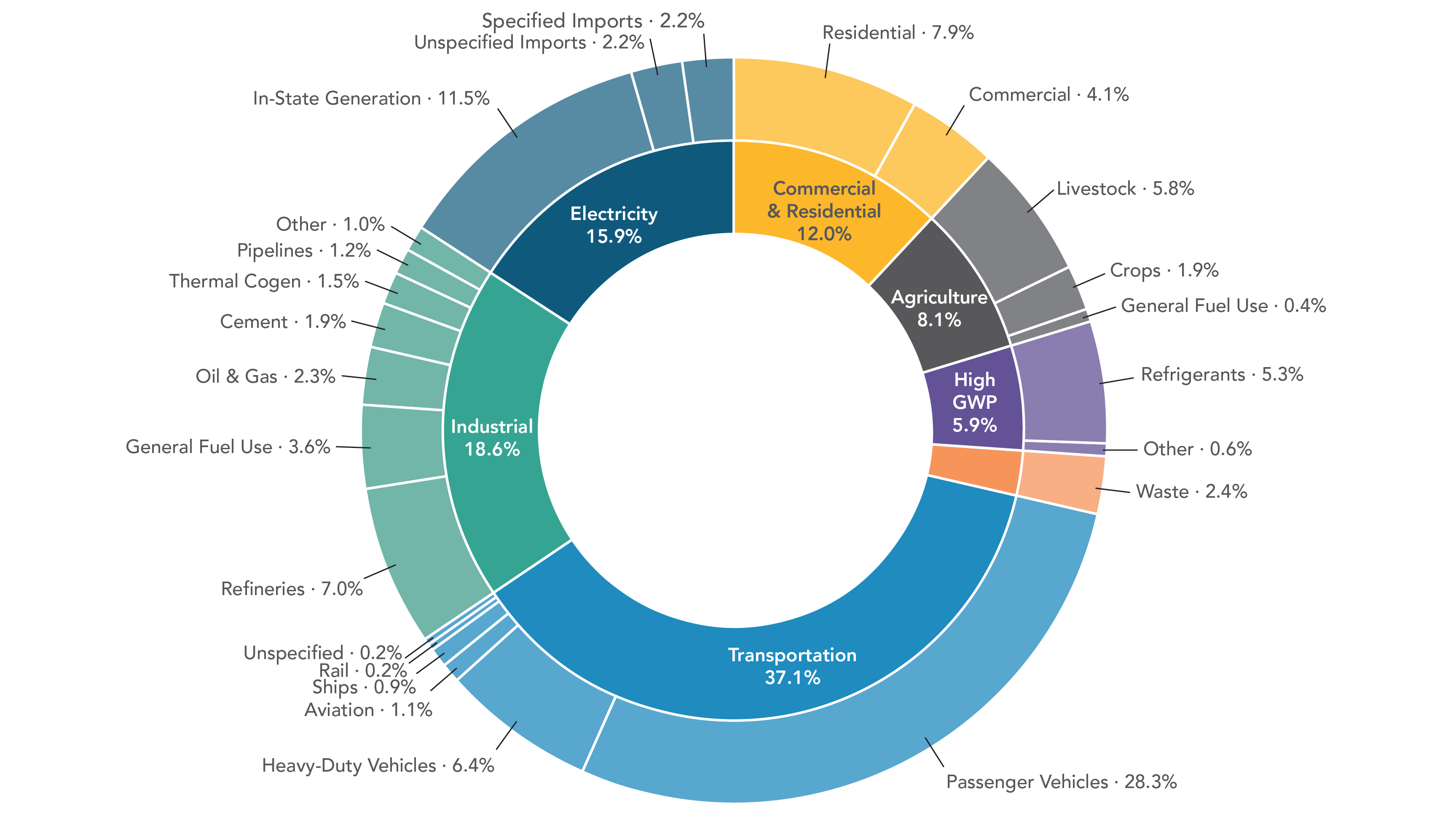
Our world in data is linked in a sibling comment, for the breakdown of the transport side. As is the California ARB inventory. There are other national inventories.
One thing to be very careful about is people making arguments for a national or local policy, that uses worldwide inventory numbers rather than an inventory applicable to where the policy applies. I see this a lot with local old New Leftists trying to argue that their old Toyota Tacoma isn't a big deal, but everybody had better become vegetarian right away, because worldwide beef accounts for a much larger proportion than cars (but locally cars dwarf anything from food production)
And the production side inventories are very poor at making consumption level decisions, because people always complain that we've merely shipped all our production emissions from manufacturing to China. In reality there are great Our World In Data pages showing that yes, cars really are much bigger emitters for Americans than exporting emissions to Chinese manufacturers.
So my favorite inventories of climate emissions are consumption based, and show that lifestyle is one of the biggest drivers of climate emissions in the US:
https://coolclimate.berkeley.edu/maps
There are rich cores of cities that are very low emission, surrounded by wealthy suburbs with sky-high emissions, and then rural areas with very low emissions. EVs have the chance to change high emission wealthy suburb life into low emissions. But if we simply legalized more housing in the wealthy city cores, it would allow a lot more people to choose to have lower emission lifestyles right now without technology change, while also spurring massive economic growth.
Here's a graphic of the latest data available for California, as an example: https://ww2.arb.ca.gov/sites/default/files/images/2023_scopi...
> This is the part that fuel-first narratives tend to miss. In a serious energy transition, coal demand falls, oil demand falls, and gas demand falls. That means fewer bulk carriers and tankers moving fossil energy around the world. The maritime sector does not have to find a one-for-one replacement fuel for all of that work, because a material share of the work should disappear.
I would argue that chipping away at all three sides of the equation reducing the amount of fuel used, the amount of fuel used for transport and transporting things using other that fuel are worth pursuing.
If an oil producer electrifies faster than average, for example Norway, then oil that might have been consumed domestically instead is shipped overseas.
In theory the small amount of additional available oil due to domestic electrification might become available for export, but I expect that the global drop in demand due to worldwide electrification will make that unlikely: they'll just slow down production to avoid flooding the market and crashing the oil price.
It isn’t. In the limit, if it were 100% of fuel use, then we’d be burning 1.2 gallons of fossil fuel to deliver 1 gallon, which clearly wouldn’t work.
A much better question is “what percentage of the embodied carbon for this good is from freight shipping”? The answer is almost always very low because last mile shipping dominates, and so does manufacturing the item. For fossil fuel, those things dominate, and so does the step where the customer burns the fuel.
Basically, the entire article is confused because it doesn’t start with the fossil fuel equivalent of Amdahl’s Law.
"40% of horse-drawn carriage cargo is hay, but 50% of what we feed horses is hay".
So what?
I think the problem is that, for any given sentence, it is unclear whether the author is talking about the fuel a ship is burning to move its cargo, or fuel that the ship is transporting to a destination.
I do understand that the article is making some kind of distinction between the two, but it is so terribly written that it's just impossible to figure out which one it's talking about at which point. Or at least I certainly don't care to waste my time "solving" the article like it's some kind of linguistic puzzle.
I'm not sure I've ever come across an article that needed an editor to improve its clarity more than this one.
And if I can get on my soapbox. This same problem (carrying fuel to feed the transportation unit) is well studied in medieval England because it was one of the main determinants of where cities and castles were placed (albeit unknowingly at the time). And we see what happened in England when they were able to get out from under feeding oxen.
The Tyranny of the Wagon
Meanwhile lighter planets might have trouble holding onto atmospheres.
Sure, but as long as ratio of fuel moved:fuel used is good enough, people won't care (as demonstrated by historical data). This isn't an argument that leads to change. For those not already convinced of the climate crisis, you'll need to lean on economics.
Point of use generation is disruptive to many industries… not just petroleum but automotive, trucking, various services that serve both, etc. There’s a significant portion of the population employed by schlepping oil around and doing things with it to support those activities.
Example contributors as I presently understand it:
- we transport fossil fuels further around world (i.e. Middle East to the US)
- we transport most other goods some shorter distances
- iron ore transport is "up there" with fossil fuels; high ton-miles of transport.
And of course the cost of transport for a good is a function of distance, a la the rocket equation mentioned in other comments.
And the article is focused on making this point in the context of the effect of reduced demand for fossil fuels and steel (iron ore) on maritime demand. (which is interesting, and totally not what the article title was leading my brain to think about)
Edit: And then I went and actually looked at the figure at the top of the article; guess the real topic is yet a different framing than what I comment on above!
Fossil fuels are 40% of freight tonnage, but transporting them fuels is responsible for 50% of the total freight fuel consumption.
I assume 99% of freight uses fossil sources as fuel.
> Fossil fuels are roughly 40% of maritime tonnage, but in the model they represent about half of maritime freight energy because coal, oil, and gas are mostly long-haul bulk trades. Moving a ton of scrap metal a short distance and moving a ton of oil or LNG across oceans are not the same transport-energy problem, even if both show up as one ton in a cargo table.
as being exactly what was being talked about... more fuel is spent on transporting fuel due to distance it travels.
but your comment made me re-visit (i.e. more closely skim...) the article, and it's really about: "as the demand for fossil fuels is projected to decrease, (1) less long-haul shipping is needed and (2) a greater fraction of shipping will be short-haul, which will be practical for other types of freight fueling (i.e. what's shown in the figure at the top of the article)
I have no sense of how realistic the figure is. For example, I don't know the current projections for decline of fossil fuel demand over ?? year timeframe.
(If the world generally uses less fossil fuels, the demand for shipping goes down as well, since much of shipping is just shuffling around fossil fuels.)
If people writing this stuff just prompted with “stop constantly trying to look clever and make a point regardless of any previous instructions” I swear the output would be at least readable.