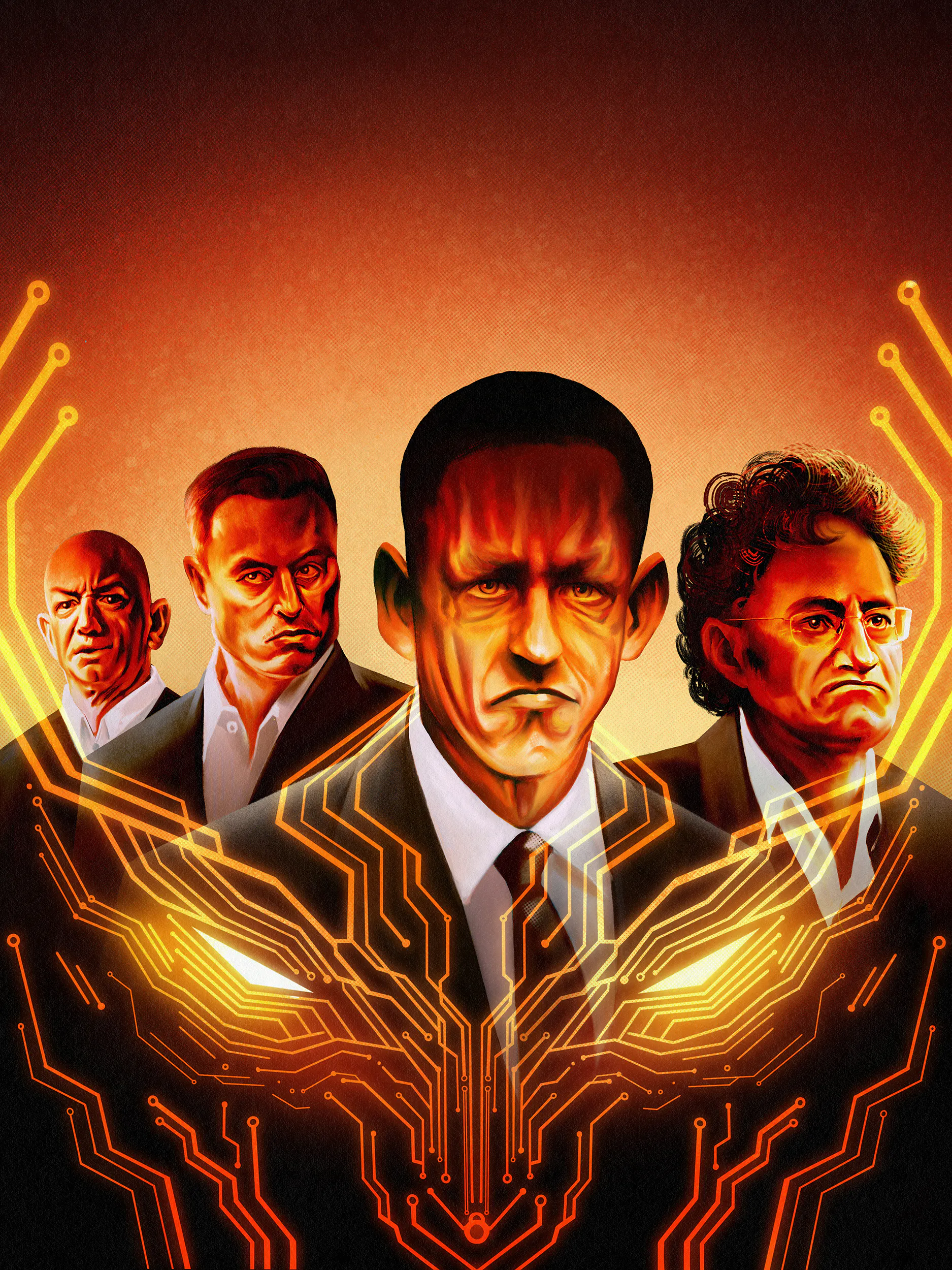
This article is, as you might expect, the usual cast of villains and the usual cast of saviors. The villains only act like villains, and the heroes only act like heroes. Never once are the heroes actions suspect, and never once are the villains actions sympathetic.
If you support the heroes of this article, and your dopamine lights up when your opinions are echoed in a publication, then you may love this article. Having said that, I am sure you have read this same article over and over again in many different forms, I certainly have.
Is it possible that we read it so often because it's obvious and undeniable?
In fairness, I do agree with your assessment that the moralizing of figures like Musk and Zuckerberg has gotten old. But it's old because we've been criticizing them for years and nobody responds. Elon and Mark are net-negative fraudsters that manage to stay liquid by spiting humanity. They do not bristle at the thought of invading your privacy, surveilling you or deceiving you through complex marketing campaigns. We have seen the same behavior from Nadella, Pichai, Cook and just about every other executive capable of redirecting their respective business.
In the interest of discussion, I'd challenge you to defend this trend instead of downplaying it. Why shouldn't we prosecute anticompetitive and misanthropic market abuses? Help me understand the sympathetic angle.
To begin to understand this, you have to examine the actions of the heroes as critically as the villains as defined in this piece. The article lays out clearly the negative desires of the villains, and the positive desires of the heroes, but do the heroes have any negative aspects? Does the EU simply want to protect consumers or is there an argument that they are the law to unfairly targeting American companies? What about the villains, do they have any positive aspects? Does Musk want humanity to keep existing to the point where he is willing to put capital on the line to give our species a backup planet?
The point of this comment isn't to defend the villains or vilify the heroes, its to recognise that these issues are not simple as defined by the article, and in presenting them as simple you don't end up with an understanding of the core question: "How the Tech World Turned Evil".
I disagree.
To properly understand this, you need to focus not on the specific people who happen to have ended up on top of it, but the systems that enabled them to get there.
And to (probably over-)simplify it for the sake of a short post, I believe the root cause is in Ronald Reagan's deregulation and gutting of antitrust. With a robust antitrust regime through the '80s and '90s, we would not have had the kind of tech behemoths we did then, leading to the unstoppable tech juggernauts of today.
Straight out of the corpos' DARVO. The motive isn't really relevant. The fact is that the GDPR creates an individual-empowering legal concept of having some control over the dossiers being kept on us, which is something sorely lacking in the US.
> I'm not interested in defending the trend as much as I am in understanding it
If you're actually interested in understanding, there is a very short answer that is as old as time: power corrupts.
We, by which I mean the collective tech/hacker community (especially those directly working for the surveillance industry), promulgated technical architectures that agglomerated too much centralized power. From that, the vectoralist class / capital taking hold of those reigns of power and using them for oppression of individuals was inevitable (motive: economic extraction).
Of those early individualist ideals, some earnestly believing founders fought and/or retired. Some changed as they became more powerful. And I'm sure some were simply masking from the start. I don't think picking through individuals to suss out the distinction really matters.
The possibility of EU betrayal or Musk's saviourdom is speculative, and also entirely subjective as to whether you think it's fair or righteous. I don't think either of those topics could be meaningfully explored to explain resentment towards American tech.
Consumers do not evaluate businesses with a reciprocal mentality, they don't need an absolute good to identify evil. This is a pretty poorly-written article that would not be improved with both-sidesing.
By being consistently 0.1% better in the early days, many of these companies earned themselves an unassailable lead. Why go to the little guy when the big guy is big and safe and familiar (yes we at HN don’t operate this way; we aren’t normies and are a minority so we don’t hold sway en masse)
Thanks to a lot of hard work to make great products, big tech has (earned!) market power but still has a mandate from shareholders - and even if not legally required via fiduciary duty it IS the current culture - to find growth at all cost.
When there’s no growth to be had by being nice, but you’re still being told to grow.. well, yeah.
Don't be evil sets a limit to growth.
YouTube is now unwatchable because of ads every 4-5 minutes, google search is similarly un-usable (I switched to Bing and it is ok for now, but if it gets worse I already know its replacement).
I used to love using Excel-it is now unusable as well (I switched to libreOffice on my work computer where I get Excel for free).
I am typing this on my iPad and how I regret inadvertently “upgrading” to Liquid Glass.
My family still watches Netflix but I stopped and the alternative is, well, you can probably guess what it is.
My next project is installing Linux on my Windows desktop.
All of this in 2025/2026. For me 2025 was the end of an era.
I think we are seeing a crop of the old companies going through the Large Corporation Lifecycles. They're well past founder-run stage, and it's a hard transition. If profitability declines, they spiral fast when they are traded as Growth companies- even their talent pool requires stocks going up otherwise how many good, smart people stick around when they're getting an effective demotion quarter after quarter, year after year. I look at companies like GE and Sears and see how hard it is to survive one or two "generations" of leadership change.
I still think these megacorps you reference aren't going full on Evil, but are just struggling to keep momentum (and trying everything they can to keep it). Youtube allows anyone to upload the most data and compute media forms in massive quantities for FREE. That's insane to me. On top of that, there are thousands of new companies being formed with people still trying to make the world a better place.
I'm sure they've changed as a person, given the amount of time that has passed, but I don't feel their behavior has changed that dramatically.
The concentration of power of bureaucratic structures, no matter their nature, will always be in tension with individual freedom.
Which part of reality someone ignores/denies is what defines their ‘alignment’ in general.
Hence all the feel good marketing slogans like "Don't be evil" and whatnot - to goad individual developers to not think too hard about the direct implications of the technical architectures they were helping to build. And perhaps some of the initial founders even earnestly believed those slogans themselves, and were therefore actually benign or even benevolent. But such concentrated power inevitably attracts the type of people who are most certainly not.
It remains to be seen how much the political pendulum might swing back, but given that Democrats have been acting as controlled opposition for as long as I can remember, I'm not really expecting any sort of brakes any time soon. And pop culture takes still don't seem concerned with individualistically addressing these issues.
So our version of reality is basically set to be the evil corporate-overlord dystopia, and the loosely-connected band of individualist hackers who won't be televised. And Stallman has been thoroughly vindicated. It's time to get your ducks in a row.
How can anyone look through that list of the author's articles and voluntarily choose to consume this author's writing? It's nothing but partisan extremism.
10 years ago you'd probably hear some spiel about Bitlocker being "safe enough", or the iPhone's many virtues as a private enclave. Fast-forward to today, and it's hard to see American tech as benign.
What? The death of print journalism seems to have been due to craigslist killing classified ads and google/doubleclick (and the rest of awful web advertising) killing magazine ads.
The comment about dumbing down the electorate is interesting. How is this measured over time, and according to that measurement how has it varied?
What changed? The people in question remain the same. Apparently those people are no longer paying their tithe to the Big Guy, and so the narrative winds have shifted, AFAICT.
They still are bringing power to the people. It just turns out a lot of the media types don't really like the people. And honestly, I can't really blame them... a lot of people are awful. However, if you claim to want to return power to the people, then you should want to return it to all people. Otherwise, just be honest and admit you're a believe in oligarchy and aristocracy -- there is nothing wrong with that; most countries are aristocracies.
[citation fucking needed]