FCMP++ upgrade will be huge for sender privacy bringing Monero's technical strength in line with ZCash.
The new site[1] looks great as well; it was funded by the CCS.
I will be buying some Monero for the first time because of this thread.
Drop a Monero address here and I'll send you a tiny amount for your first transaction.
I recommend CakeWallet, which is cross-platform, user friendly, and does a lot of good for the community, but any of the wallets recommended on the official[1] website are fine.
p.s. you or anyone can reach out via my contacts in bio if you have any questions about Monero.
Drop me your address, and I will also send a little bit your way, to get you hooked!
45nQZrXEDSL8UPj7DeJRrcdFkAteCajG4bGGsQP7cmWwiZU63dpfWe9RPpas38BAU4Kwv5NSKBsnacXewQszMhrx7fgTQLe
My new address is
49jUau1t16ZPtBNFaJ2o5eW79x6Fui14AbqwQyovBe2V6LdwgWrHkniWTV9dj7tAY8SRxsshkmQEwLCBYUvPFEkZBJGZt6n
Where do you recommend trading dollars -> Monero?
A. Determine where you are. Are you in a jurisdiction that has CEXs[2] that allow you to purchase Monero with Fiat? If so, Continue to B; otheriwse, continue to C.
B. If you are in the USA/Country where you can buy Monero directly:
1. Open a Kraken[3] account. You will need to prove your identity through a service like Persona.
2. Send money into Kraken from your bank or credit card.
3. Purchase Monero on Kraken with your deposited funds.
4. 7-day hold and then you will be able to withdraw to your self-custody wallet.
Conclusion: You now own Monero. You have payed minimal fees. The government and entire financial system knows you have purchased Monero.
This may or may not be a concern depending on your threat model[4]. Many people overstate this threat—Monero is the 14th largest Cryptocurrency by market cap, it is not particularly suspicious to purchase it. It does not compromise your future Monero transactions—it is just like withdrawing cash from an ATM, the financial system and government know that you now hold cash, but what it is used for is opaque.
C. If you are not in the USA/are in a jurisdiction where you can't buy Monero directly:
1. Open an account on any KYC CEX, I recommend Kraken. You will need to prove your identity through a service like Persona.
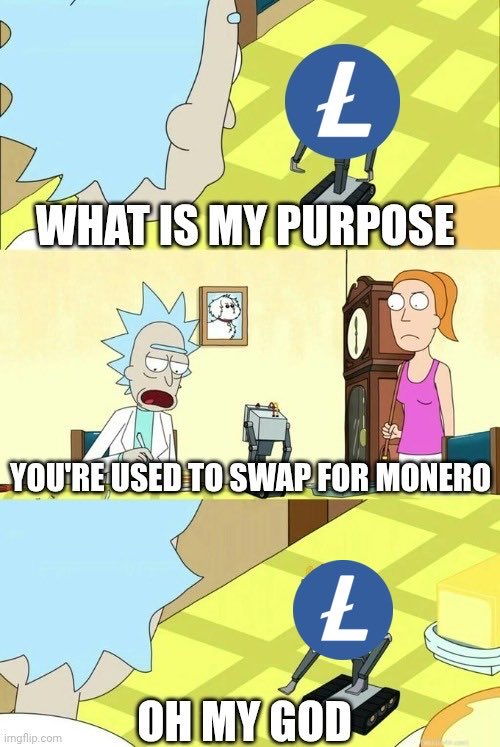
2. Purchase any coin. I recommend Litecoin[5], but Bitcoin or anything works.
3. Create a self-custody wallet for Litecoin, I recommend CakeWallet.
4. Withdraw your Litecoin to CakeWallet.
5. Go to Trocador[6].
6. Create a swap from Litecoin to Monero.
7. Give Trocador one of your Monero addresses to send the converted Monero to.
8. Choose the exchange with the best fees/privacy to your liking (these change throughout the day).
9. Send your Litecoin from CakeWallet to the Litecoin address provided.
10. You will shortly receive Monero to the address you gave Trocador.
Conclusion: You now own Monero. You have payed a small amount of fees. Depending on the pervasiveness and intelligence of blockchain surveillance, the financial system and the government knows that you have purchased Monero, or has the ability to figure out that you have purchased Monero.
All your future transactions are anonymous. Remember, Monero is just patching one hole in making an anonymous transaction. It does not magically make you anonymous if any of these other things are not anonymous: OS, browser, IP address, identities, etc.
[1] Know-your-customer — they say it's to stop crime.
[2] Centralized Exchange
[3] As respected of a CEX as you will get. They support Monero while most other CEXs have removed it.
[4] https://www.privacyguides.org/en/basics/threat-modeling/
[5] Low fee POW (proof of work) crypto. The second crypto to be created after Bitcoin. https://pbs.twimg.com/media/HDyfsemWoAAOLVM.jpg
[6] [https://trocador.app Highly reputable instant exchange aggregator. They do not touch your funds, they just aggregate other instant exchanges and provide a guarantee for no-KYC. Excellent customer support. You will pay about a 1% fee converting your crypto through an instant exchange. Instant exchanges are CEXs, but since they deal only in Crypto and not Fiat, they can afford to easily be no-KYC.
And interestingly, it's one of the least-used least-hyped options. It's as though we didn't actually want privacy in our money system.
I think a hint into this is actually in one of these posted features: https://repo.getmonero.org/monero-project/ccs-proposals/-/me...
One of the reasons for building a proper payments system is "Casino games"...
While I am here, I might as well give you a brief Esperanto lesson. Mono = money, ero = piece/quantum. So, "pano" = bread, "panero" = bread-crumb. Thus, "monero" = coin.
Many previous international currencies (all of them created with Swiss involvement), were also given Esperanto names: Spesmilo (thousand speso's (speso is analogous to "penny")), Stelo (star).
There is even a luxury watch-brand (from Switzerland) called "Movado", which is Esperanto for "Movement" (made back when watches were made with mechanical movements).
And I also learned, from the linked thread (disclosure, I am a participant), that there is a soft-drink called "Mirinda". This is an adjective that means "awe-worthy".
[1]: https://www.reddit.com/r/Esperanto/comments/1sobiko/comment/...
There is lots of interest from individuals. But governments all around the world have done their best to suppress it. They indeed do not like privacy and independence. They are the ones who sued and pressured exchanges into delisting Monero.
ETA: just to be clear - that's a genuine question. I don't know much about monero, so if it really is possible to have untraceable money, that seems like a prudent investment for precaution. I've just always assumed that digital money is inherently traceable, so I always assumed genuine privacy is a mirage. I assume I'm wrong about that, somehow, so I'm curious about the mechanisms of that anonymity.
sorry to ask, but the website seems very light on any actual technical detail about how they are achieving their privacy claims - at least in terms I can parse to make them understandable to me.
[1] https://np.reddit.com/r/grincoin/comments/mu88ow/comment/gv6...
Monero's transaction fees are less than Bitcoin's:
https://bitinfocharts.com/comparison/transactionfees-btc-xmr...
And Monero's fees decrease with larger block sizes (Monero has dynamic block sizes) whereas Bitcoin has a fixed block size and fees must increase to compete to be included in the block.
And when they're not?
For comparison, XRP already has a roadmap: https://cryptonews.com/news/ripple-post-quantum-readiness-xr...
It looks like you're referring to the tail emission which solves the problem that Bitcoin has.
Also, it is a small fixed amount of "coins", so the actual inflation rate approaches zero.
I think your comment is what they call "F.U.D."
Which problem are you talking about? It being deflationary? You might not think it's a good idea, but it's not a problem if it's by design.
So either fees will be expensive, or there won't be miners securing the blockchain.
Now THAT is FUD. Current annual inflation rate is 0.84191433% [0]. That is massive and not "approaches zero". The value of Monero over n-years thus approaches zero over time, for big enough n.
While that is a little under 1%, it is still inflation. The ECB targets on average 2% inflation (while before COVID the ECB targeted maximum of 2% - so actually close to the Monero inflation).
It looks like we have different definitions of "massive".
You also say it does not approach zero, but in the following sentence you do say it approaches zero.
I guess people need to decide if inflationary money is better or worse than deflationary money, and what amount of inflation is appropriate.
Personally, without too much thought: I think a monetary inflation rate should correlate with the population inflation rate, so that it's value remains somewhat constant (I'm open to changing this opinion with more information).
Just look into cypherstack and the "paid" ccs employees.
All the people who get huge grants are insiders.
Official condemnation doesn't work like that. Facebook's cryptocurrency, Libra, was also condemned, and we know it didn't work because it never actually existed.
I asked an honest question about the pros and cons. Every technology has pros and cons, right?
And outlawing bitcoin has become basically impossible after the large amount of ETF inflows. Monero is nice technology, but I think the ship has already sailed for Bitcoin (and L2 solutions like lightning).
"decently"?
It's either anonymous or not.
And the lightning node operator can see the transactions, so no, it's not anonymous.
I disagree. Either someone is known or they are not known.
I am not a bitcoin-as-currency evangelist. I see it more as digital gold, and gold is not a currency today. It will have its role as a store of value and fallback unit of trade that keeps government currencies in check - another pillar in financial checks-and-balances.
So the 'true cryptocurrency' hasn't been tried yet, eh? ;)
Any high-volatile asset such as bitcoin is IMHO not suited as currency. The good news is, with the bitcoin taproot upgrade and latest lightning standards, you can actually issue stablecoins over bitcoin's taproot asset protocol, and send it over the existing lightning network. My bet is on stablecoins-over-lightning as currency, and bitcoin as store of value. One blockchain to rule them all, other chains not need (for financial transactions at least).
Plus the global transaction rate would also stop it really being useful for day to day spending for a country.
No, Layer-2 systems only transfer cryptographically signed IOUs between nodes.
Settlement only happens when these IOUs are cashed out, and to cash out you need a transaction in the blockchain layer, so the point about latency still stands.
  - insufficient liquidity on intemediate nodes
  - network partitions
  - uncooperative nodes
  - nodes that were liquidity sinks and forced other participants to bear the costs of deposits
  - insufficient market makers
you are moving the goalpost in the discussion of this thread. User KaierPro said bitcoin would not be suitable because transactions takes to long, to which is responded lightning solves that. Now claiming that other cryptos can have layers-2 is correct, but adds nothing to the discussion or my initial point. Yes other chains have faster settlement times, and can have their respective payment channels - no one argued against that.
Theoretically.
In practice, it has shown that it is only viable if adoption by number of nodes and TVL grew by orders of magnitude, and both are very unlikely to happen because - like I said - spenders have nothing to gain from it and no matter how much of the UX friction is solved, it will never be as easy as paying with credit card.
The only people who want to use Lightning are the ones who are invested in Bitcoin. Everyone else just want simple/safe access to a payment network.
Most spenders will prefer credit cards, but there is a non-zero group where absolute privacy is important and monero is the better choice, therefore more valuable to them.
You are the one trying to make some false equivalency by saying that "bitcoin/lightning is good enough for most cases, therefore there is no need for monero".
The problem is that you are starting with the conclusion that you want (i.e, "Bitcoin is the best") and you are working backwards from this conclusion to make all sorts of rationalizations. Try going from the use case first and then let's see where the reasoning takes you. You will see that for pretty much ANY use-case, Bitcoin is not the answer.
Bitcoin Lightning is cryptographically designed to be valid even if it's not yet settled on the main layer. It provides cryptographically sound mechanisms to overrule anyone that tries to "cheat". There is no mathematical way to cancel or double spend it, just like your dollars are valid when the transaction is committed in your bank's database although the money still technically hasn't left the other bank.
Anything offchain has a whole bunch of issues that are either naively or deliberately obscured by the fact that it _eventually_ writes to the blockchain. The exchanges that offer instant settlement are circumventing trust by doing the settlement for you. You get speed, but not security that they have done what they have said they have.
To be honest I think the issue here is not due to speed of settlement, but layer-2 is not an acceptable substitute because it does not allow reversability. For the merchants it's good that they are getting the money right away, but most consumers will not dare to pay anything via layer-2 networks simply because they won't have any recourse in case they want to undo the transaction.
How long it's going to take you to realize that even if we built everything you are asking for, we are STILL going to end up with a system that is not as capital-efficient as the status quo?
And the US government is being bribed by Silicon Valley to adopt crypto...
> I am not a bitcoin-as-currency evangelist
Then why all the talk about Lighning and the dismissal of Monero?
- Ethereum's blockchain consumes less energy, is more decentralized, it's a lot more resistent to any form of attack and it can also host fixed-supply coins.
- Market cap is a meaningless metric, it's at best circular logic and at worst it's just a "one billion flies can't be wrong" argumentum ad populum.
- It baffles me how the Bitcoin enthusiasts talk so much about ideology and freedom, but get completely silent about the fact that most mining operations are done in countries with oppressive regimes, financed or subsidized by dictators with access to cheap fossil fuels.
"Fully anonymous" is a strong term. Even cash is not fully anonymous. I would give monero that it is more anonymous than lightning because it is a core design principal. There is a spectrum to anonymity, however. As public enemy number one, such as Snowden or BinLaden, your anonymity requirements are different than a citizen buying illegal erectile dysfunction medication online.
If you consider the new features added in lightning over the past 24 months such as trampoline payments, blinded paths etc. - you will find that lightning is anonymous enough. Plus, you can increase anonymity in the client implementation at the expense of higher transaction fees (longer paths, more trampolines). Lightning's BOLT12 standard, which is currently finalized, will increase anonymity even further.
> Ethereum's blockchain consumes less energy, is more decentralized, it's a lot more resistent to any form of attack and it can also host fixed-supply coins.
Thats is factually untrue. First, ethereum famously had a human-coordinated rollback with a controlled restart organized between devs and node runners over Discord. Second, Ethereum is not decentralzied at all, because that is a core property of proof-of-stake: There is no way at any given time that you can be sure that the majority stake is not already in a single entities (or colluding group) possesion - and would thus have absolute control. It is therefore never guaranteed at any given time, that the network is decentralized.
> Market cap is a meaningless metric, it's at best circular logic and at worst it's just a "one billion flies can't be wrong" argumentum ad populum.
Price is ultimately what determines the value of anything. It is absolutely far from meaningless, as the market cap is also a big factor if a crypto asset can be outlawed or banned. Given how many investors in the west already own bitcoin, there would be a massive outcry if it is suddenly outlawed. I say you could outlaw Monero tomorrow and the mainstream media wouldn't even cover it.
> It baffles me how the Bitcoin enthusiasts talk so much about ideology and freedom, but get completely silent about the fact that most mining operations are done in countries with oppressive regimes, financed or subsidized by dictators with access to cheap fossil fuels.
You mean, such as the United States? Because the US (especially Texas) is one of the biggest miners of bitcoin currently.
But you can only make any claims about the properties of a system when looking at the extremes. If Bitcoin's blockchain does not make strong anonymity guarantees as Monero, then Bitcoin by definition can not be the "blockchain to rule them all" that you so desperately want.
>ethereum famously had a human-coordinated rollback with a controlled restart organized between devs and node runners over Discord.
That was achieved through social coordination. No backdoor was exploited, no one had their coins stolen on the original chain. The system worked as intended.
Can you say the same about Bitcoin? Do you think that all these banks and exchanges trading ETFs have secured access to the bitcoins they claim to have? When one of these institutions goes bust, who is going to bail them out?
You keep trying to argue that Bitcoin is more valuable because it is more likely to be supported by the powers-that-be, and that is the strongest indicator that all your evangelism is driven by "Greater Fool" dynamic. Satoshi's idea for crytocurrencies was to have an alternative system that worked despite adversarial governments, yet we keep getting time-and-again evidence that it can only work if it becomes of an instrument for the powerful institutions that caused the problems in the first place.
Bitcoin and its blockchain has no intrinsic value. Unlike Monero, it is not fully anonymous. Unlike Ethereum, it has no utility for decentralized applications. It can not be used as a currency. All Bitcoin has is first-mover advantage and a huge number of people with cognitive dissonance trying to keep the bubble inflated.
> Because the US (especially Texas) is one of the biggest miners of bitcoin currently.
Access to cheap fossil fuels? Check.
Facilitated by the government? Check!
Serving the interests of the elites and the aspirational 14% instead of the general populace? Check!
What are the pros of Monero, and what are the cons?
Pros:
1% inflation
no fixed supply (makes it more of a currency than an asset)
privacy by default,
fungibility—every coin is the exact same, no coin history
prevents financial surveillance by corporations,
protects against government abuses,
useful tool for activists, journalists, minorities, useful for domestic abuse survivors,
useful for businesses sending money across borders,
protects against stalkers,
protects against advertisers profiling you,
reduces identity theft,
prevents databreaches of personal info,
pushes forward cryptography,
allows people to purchase drugs (you decide if this is good or bad),
prevents financial censorship,
allows anonymous donations,
low fees,
more decentralized than bitcoin due to RandomX CPU mining,
prevents crypto robbery,
allows you to buy your adult content without anyone knowing.
large developer community iirc 3rd after bitcoin, eth
less volatile than other cryptos
usually most used crypto for payments when accepted at merchants
Cons:
20 minutes to use funds again
hard to aquire
number go up slower
hard to convert back to fiat
hard to convert to fiat
used by "criminals"
lots of nazis like it
used for unethical purposes
The problem with Lightning or Zcash is that it is not private by default. A private currency has to be private by default, with the option to share info on the transaction—that's Monero.
Lightning is centralized, Chainalysis supports Lighning tracing—it does not support Monero tracing.
You could get the same advantages of Lightning on Bitcoin by making a layer-2 solution on Monero. Monero beats lightning at layer one.
apart from waiting for the confirmation, otherwise you're in double spend territory.
con: this improves the chances if the world to devolving into an authoritarean hellscape